





Three Instagram accounts receive DMs at the same time: one asks about shipping time in English, one asks about sizing in Spanish, and one sends a screenshot directly in Arabic. The customer service agent understands every sentence but sends the Spanish reply from the English account; during handoff, no one can say clearly whether the quote for this order has been confirmed. The problem is not whether translation is accurate, but that the translation is not linked to a specific account, customer, and next action. The following discussion is about how to integrate Instagram cross-border translation into daily customer service processes, not about how to install a single-sentence translation plugin.
First distinguish three search terms: ins multi-account, Instagram cross-border translation, and Twitter lead-generation work orders
ins multi-account software solves simultaneous login and parallel account operation: several accounts can be online at the same time without repeated switching.Applicable scenarios and operational boundaries of ins multi-account software from the perspective of Instagram multi-account managementThis boundary has already been explained clearly: multi-account only goes as far as being able to receive messages simultaneously; once messages arrive, it is not responsible for who replies or in which language.
Instagram cross-border translation software handles understanding and two-way replies at the conversation level: translating the other party's words in, translating what you want to say out, and ensuring the translation follows the specific conversation. Twitter lead-generation work orders, by contrast, lean toward lead acquisition and work order flow, with their main focus on the Twitter side; this is not the same as Instagram DM customer service. The three can coexist but cannot replace one another: using multi-account software instead of translation results in seeing messages but replying poorly; handling DMs with a lead-generation mindset makes customers feel they are being treated as a list.
This article focuses on only one thing: at which points cross-border translation should be connected in the process from when an Instagram DM arrives to when follow-up ends.
Define account ownership before onboarding: who is responsible for which Instagram account
If account ownership is not defined, the smoother the translation, the more likely things are to go wrong, because fast replies also mean fast mistakes. Before onboarding, do an inventory and write the following items on a single sheet of paper to post next to the workstation:
- Account list and login owners:the login device, actual user, and backup login person for each Instagram account.
- Customer service owner:At least one primary owner per account, to avoid everyone being able to reply while no one is truly responsible.
- Market or language tag:whether this account mainly handles English-, Spanish-, or Arabic-speaking customers, which determines who should review it.
- Direct message assignment rules:assign by account, by language, or by customer type; choose only one primary rule, otherwise boundaries will conflict with each other.
- Handover person:who takes over on rest days, leave, or shift changes, and which record to continue from after taking over.
SKY SCRM's public business positioning is aggregated translation and customer management, supporting multi-account management across global social platforms; the role of such tools is to bring messages from multiple accounts into one place, but the prerequisite remains that account ownership is first clearly defined within the team. Account login methods and platform handling rules are subject to Instagram official help centeras explained there; the tool is only responsible for message aggregation and communication efficiency.
When direct messages come in, triage first: which ones to translate directly and which ones to create a customer profile for first
Not every direct message deserves the same processing cost. Triage into four categories to save a lot of back-and-forth confirmation:
- First-time inquiry: First check the language and intent, create a minimal profile (source account, language, what they are asking about), and then translate the reply. The profile can be very short, but it cannot be omitted.
- Existing customer follow-up: First pull up existing records, confirm what price was quoted previously and what information has been confirmed, and do not ask again from scratch.
- Quotes, addresses, and orders: The original text must be retained; the translation is only for comprehension assistance. Key fields must be manually checked before sending.
- After-sales and complaints:Handle with priority, and do not rely on machine translation for the final judgment. Tone deviations carry the highest cost in complaint scenarios.
When the same customer appears under different accounts, merging must be conditional: same name or same avatar, self-reported same need, and matching the same order number—at least two of these three conditions must be met before merging; otherwise, it is better to keep two records and merge them after confirmation. Retaining both the original text and the translation is a hard requirement; if only the translation is kept, no one will be able to verify later what the other party actually said.

Reply stage: beyond bidirectional translation, the original text and tone must be preserved
The most common mistake when replying is to edit only the translation. A translation is second-hand information to begin with; rewriting directly on the translation amounts to a second relay between the two languages, and the meaning will drift from the original. A more reliable sequence is: first read the original to confirm what the other party wants, then decide how to answer in your own words, then have the tool translate it into the other party's language, and read it back once before sending.
Reply templates can be used, but clear boundaries must be drawn. Information such as forms of address, quotations, dimensions, addresses, and times must be manually checked item by item; templates are only suitable for low-risk content such as openings, thanks, and process notifications. In addition, the original text, translation, and sending account must be bound to the same conversation: if only the translation is saved, when someone else takes over, they will know neither what the other party originally said nor which account the message was sent from.
For a more detailed understanding of the implementation sequence of bidirectional translation in direct messages, refer toHow to implement real-time translation chat on Instagram, in which the process from account connection to reply attribution has been fully broken down.
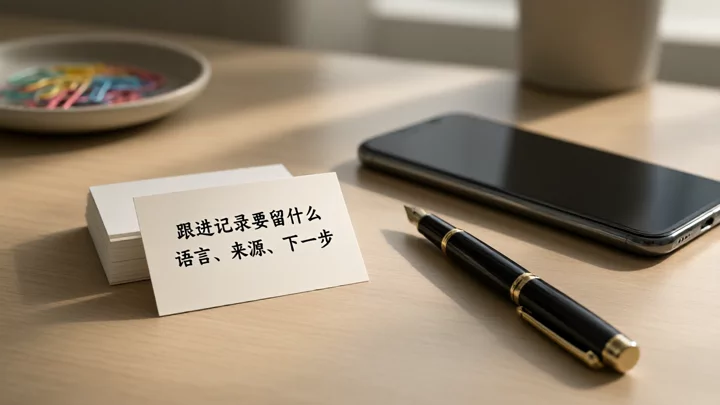
Follow-up stage: record language preference, account source, and next steps in the customer record
Follow-up records do not need to be complicated, but if a few fields are missing, they will lead to repeated questions:
- Language preference: which language the customer prefers; use it directly next time without repeatedly testing.
- Source account: which Instagram account this customer came in from; replies must also go out from the same account.
- Initial request: what was asked initially, so follow-up does not drift off track later.
- Confirmed information: price, model, address, time—write clearly what has been confirmed and mark what has not.
- Next action and timing: who will do what and when—whether sending samples, waiting for payment, or waiting for the customer to send images back.
Among these five items, the one most often missed is the “source account.” When operating multiple accounts, a customer may have chatted on two accounts; if this is not clearly recorded, replies can easily be sent from the wrong account.Use an Instagram chat translator for cross-language communicationThere is a more detailed discussion of how account ownership and translation reuse are handled.
Small-scale pilot acceptance: start with the four failure points; do not rush to expand accounts
Run 2 to 3 accounts and 1 to 2 languages for two to four weeks; this makes problems easier to see than connecting all accounts at once. For acceptance, do not rely on a vague feeling like 'whether the translation is accurate'; look at four countable failure points:
- Wrong-account reply count: How many replies this week were not sent from the source account.
- Repeat question count: The same customer was asked the same question twice.
- Missing source text count: The source text cannot be found when the original wording needs to be verified.
- First response after handover: After a handover, does the first reply connect to the previous context?
If any one of these four items keeps occurring, it means the process has not yet been stabilized; expanding accounts at this point will only amplify the problem. The multilingual DM and customer management approach on the Twitter side can be cross-referenced; seeWhen using transquickly to handle multilingual communication on Twitter, what should be noted for customer management?; if the team is already using kt工单 to handle communication,How should kt工单 connect with customer communication on social platforms?It covered the timing for creating tickets and the issue of carrying context over. The criterion for choosing between the two platforms is whether the same group of customers overlaps, not whether the tools are unified.
Frequently Asked Questions
Are Instagram cross-border translation software and ins multi-account software the same thing?
No. Multi-account software solves simultaneous login and parallel account operation, while cross-border translation solves conversation understanding and two-way replies. The former lets you receive messages at the same time; the latter determines how to reply once messages arrive and from which account. Installing only multi-account software does not solve reply quality, and installing only translation does not solve account confusion.
After translating DMs across multiple accounts, how can customer service avoid replying from the wrong account?
Handle it at two levels: at the account level, assign a primary owner and language tag to each account; at the conversation level, bind the original text, translation, and sending account to the same record. Before sending, confirm the source account of the conversation rather than choosing an account based on impression.
When customers repeatedly inquire in multiple languages, what are the minimum fields that should be kept in follow-up records?
Language preference, source account, initial request, confirmed information, next action and timing. Of the five, the easiest to miss is the source account; if it is missed, you may reply from the wrong account, and the customer may receive two inconsistent messages.
For teams searching for “Twitter follower-growth work orders,” do they need work orders and Instagram DM translation connected together?
Check whether customers are cross-platform. If the same group of customers appears on both Twitter and Instagram, at minimum the work order should carry the customer’s language preference and confirmed information; if the customers on the two platforms do not overlap at all, handling them separately is easier—there is no need to unify for the sake of unification.