





For 海译通工单 to take over customer follow-up after multi-account social communication, the key is not to move chat summaries into the ticket, but to let every conversation that needs follow-up leave four types of handover information in the ticket: account ownership, customer language preference, current stage and owner, and handover record. If any one item is missing, the ticket degenerates into an empty shell containing only the three words “follow-up in progress.”
A Vietnamese-speaking customer asks about the price on Zalo, then goes silent, and two days later asks again in English on Facebook; if the ticket does not clearly state “who handled it on which account, what language the customer prefers, and who will do what next,” the colleague after the shift change can only go through the chat history again.
The Four Types of Information That 海译通 Work Orders Must Capture
In social communication scenarios, the action of a “ticket” comes down to one sentence: turn a conversation into a follow-up item that has an owner and a verifiable record. To achieve this, all four types of information must be present at the same time.
- Account ownership: which platform and which account this conversation comes from. The same customer may have sent messages on both WhatsApp and Instagram; if ownership is unclear, replies may be duplicated or responsibility may be passed back and forth.
- Customer language preference: Which language the customer speaks in and which language they prefer to receive replies in. Translation helps people understand, but it cannot remember this for the team.
- Follow-up stage and owner: Whether the deal is currently at inquiry, awaiting a quote, awaiting payment, or lost, plus who will take the next step and when.
- Traceable handover record: When someone else takes over, they can understand the context without going through the chat history again or retranslating it.
If any one of these four is missing, follow-up will break at some account switch or shift change. A ticketing system is only a container for them; if fields are left blank and definitions are unclear, it still won’t hold the handover together.
The three places where 海译通 tickets most often break during multi-account handovers
Imagine a typical three-person team: A handles Vietnamese-speaking customers on Zalo, B handles English-speaking customers on WhatsApp, and C handles DMs on Facebook and Instagram. A customer asks about pricing on Zalo, then goes quiet. Two days later, they ask again in English on Facebook. C responds but does not know this is an existing customer.
The first break is at account switching: C sees a brand-new conversation, while the history sits in A’s account, physically separate. The second break is language preference: C replies in Chinese. The customer can understand it, but the experience is already diminished, and the earlier communication in Vietnamese was not recorded. The third break is follow-up stage: A remembers that “this customer thinks it’s too expensive,” but that sentence exists only in A’s head, not anywhere that can be handed over.
Many people think opening a ticket will solve it, only to end up with a single line in the ticket: “Status: following up.” Such a record is of almost no value to the next person handling it, because it does not answer the four questions: account, language, stage, and next step.
The minimum recording standard for 海译通 tickets: how to write a handover card
You don’t need to design a complex field system from the start. Give every conversation that needs follow-up a “handover card,” with one sentence for each of the four pieces of information, as long as it can be understood. Below is the minimum standard you can copy directly.
- Source account:Format as "platform + account short name", e.g. "Zalo-Vietnam account 2", "IG-Main store". Do not use labels that cannot be traced, such as "customer service account".
- Language preference:Format as "the customer speaks Vietnamese; reply in Vietnamese, English can be used as a supplement". If the customer switches language mid-conversation, note which message the switch started from.
- Current stage and next step:Write "FOB price quoted; the customer finds it high and is waiting for internal confirmation, follow up in three days", not "following up". Include the time and the specific action.
- Handover notes:Only write what the person taking over must know, e.g. "the customer does not accept orders below a certain quantity", "samples promised, tracking number to be added".
海译通 tickets are for follow-up, not for counting
Searches like "海译通 counter" usually point to a different question: the team wants to know how many times translation was used, which account has the most messages, how fast responses are. Such statistics answer "how much happened", while ticket handling answers "who does what next". The two cannot replace each other.
| How to record | Typical questions | Answers it can provide | What it cannot replace |
|---|---|---|---|
| Counting and statistics only | How many customers did this account serve this week? How many times was translation used? | Quantified measures of workload and usage | Cannot show how far a particular customer has progressed |
| Handover records for tickets | Who is handling this customer? What is the next step? | Owner and stage, suitable for handover | Cannot reflect overall reception volume |
In practice, first use handover records to make sure no individual customer is lost, then use the statistical measures to see team load; reversing the order easily leads to the situation where "the reports look great, but no one is replying to customers." As for which communication metrics a multi-account team should track, you can refer toWhich communication metrics should ws计数器 trackthe breakdown of definitions in it.
When 海译通 work orders are used for social communication, three boundaries need to be agreed on in advance
海译通 work orders are not a social platform themselves. When they carry multi-account communication, there are three areas the team has to fill in on its own.
- The original conversation is not in the work order: a work order usually holds only a summary; the customer's exact words, the context, and the translation results stay in the chat tool. The person taking over often has to check both sides.
- Multi-account attribution has to be maintained manually: the work order system does not know which platform account a message came from. That information either depends on someone filling it in or on an external rule being agreed on, and a wrong entry is as good as no entry.
- Multilingual context is easily lost: the customer's original words were in Vietnamese, but the work order records a Chinese summary. After several rounds of handover, no one remembers how the customer actually phrased it, and the tone of the reply drifts with it.
This is not to say that 海译通 work orders are bad; rather, the main scenario they serve requires the team to bring the context of social communication in. If the team's main communication happens in social platform direct messages, the handover layer should sit as close to the conversation as possible.
If the team also uses SKY SCRM, it is positioned as an aggregated translation and customer management system that supports multi-account management across global social platforms, multilingual communication, AI translation, and customer management. It handles the conversation aggregation and translation part, while 海译通 work orders handle the follow-up items after the conversation; with clear boundaries between the two, follow-up will not break down.
If your main pain point is that you understand the translation but reply in the wrong language, start witha breakdown of the multi-language customer communication and follow-up workflow; if the problem lies at the account level,Zalo multi-account login and switchingthe checklist in it is more direct.
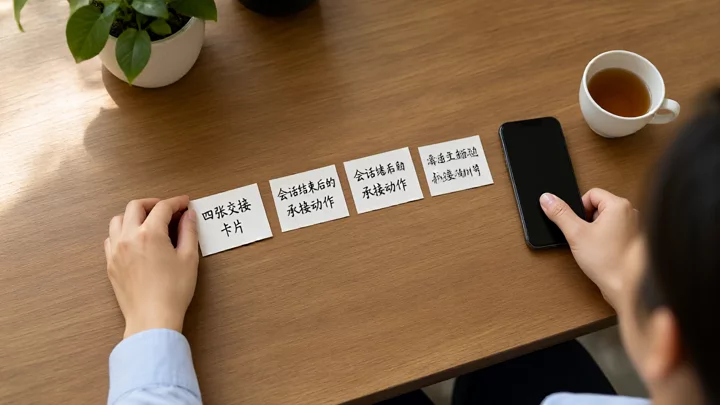
Before rollout, use one real conversation to verify whether 海译通 tickets can handle it
Don't roll it out to the whole team right away. Pick an ongoing multilingual conversation, walk through the steps below, and after three days you'll be able to see whether the handover chain holds up.
- Choose a real conversation: prioritize customers who span two platforms or two languages, as these are most likely to expose breakpoints.
- Write a handover card with four pieces of information: source account, language preference, current stage and next step, and handover notes. One sentence for each item, and finish it within five minutes.
- On the third day, have a colleague who wasn't involved take over: give them only this card and see whether they can send the next message directly. Wherever they get stuck, fill in that item.
When validating, watch for two things: first, whether writing the card takes longer than handling the conversation itself; if so, the fields are too complex and need to be simplified. Second, whether the person taking over still needs to scroll back through the chat history; if so, the language preference or context was not captured properly.

Frequently asked questions
If a small team has only two or three people, do they also need to write the four pieces of information in a 海译通 ticket?
What you need is a handover action, not complex software. A team of two or three people also works shifts, takes leave, and switches accounts; the four pieces of information can be put in a shared spreadsheet to get started. The key is to write them every time you hand over.
What is the minimum that must be written in a multilingual handover?
At a minimum, clearly state what language the customer uses, which language has been used to reply previously, and which language the next message should use. The other three items can be abbreviated, but the language item cannot be omitted; it directly determines the customer experience.
Why is it not enough to write only “following up” in a 海译通 ticket?
Because it does not answer the source account, language preference, current stage, and next action. When the person taking over sees these three characters, they still have to scroll back through the chat history, which means no handover took place.
If the count data looks good, does that mean there is no problem with follow-up?
No. Counts reflect reception volume and translation usage, but they cannot show whether a particular customer has been replied to or how far the follow-up has progressed. The two should be viewed separately; statistics cannot replace follow-up records.
Can a general-purpose ticketing system be used directly for social communication?
It can be used, but the original conversation, account ownership, and multilingual context are usually not included, so the team needs to agree on additional entry rules. If communication mainly takes place through social platform direct messages, prioritize an intake method that is closer to the conversation.