




First, clarify: which account should the translation land in
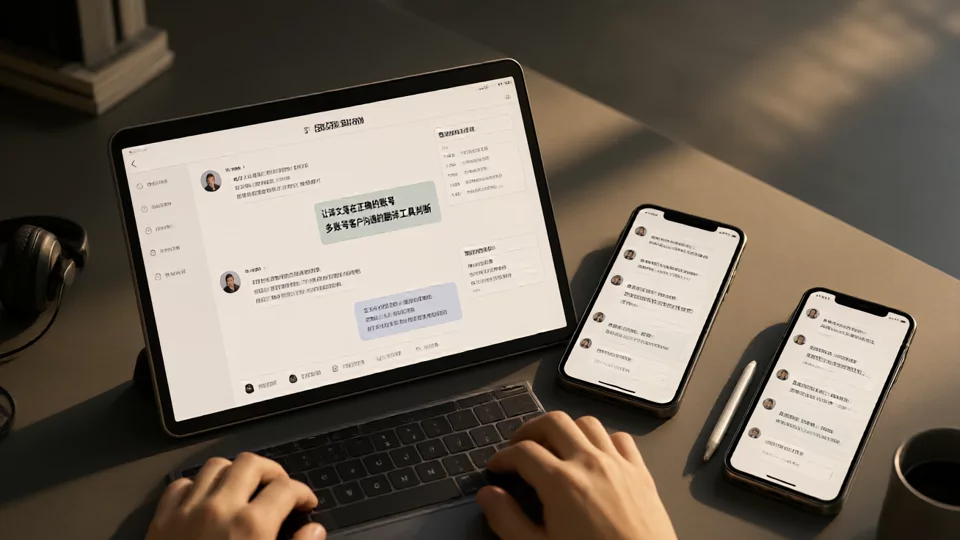
Three accounts receive foreign-language direct messages at the same time; you understand the content, but you send the quote to a customer window on a different account. Such rework is rarely caused by inaccurate translation — it comes from translations, account ownership and customer records being scattered across three places. What people searching for "cc translation software" really need to judge is not which tool renders a single sentence smoothly, but which tool can make the translation appear in the right account and the right conversation, so that whoever takes over does not have to translate everything again.
First write the requirement in one sentence: I need one place where I can see messages from multiple social accounts at the same time, read the original text and the translation, reply in the customer's language, and keep this communication under the customer's name. If the last two points cannot be done, the tool is just a personal translator.
The dividing line between the three approaches: account ownership and handover records
Solutions on the market roughly fall into three layers; the difference is not the translate button, but who the message belongs to and where the record stays.
| Solution type | Account and translation ownership | Customer information and handover | Suitable scenarios |
|---|---|---|---|
| Personal translation tools (browser extensions, standalone translation apps, input method translation) | Translations are generated in the tool, accounts are tracked manually, and the same sentence must be translated again when switching accounts | Customer information is not retained, and handovers rely on screenshots and verbal explanations | One person, one account, low message volume |
| Multiple platform instances with translation | Multiple clients or multiple windows each come with translation, accounts are distinguished by window position, and with many windows it is easy to mix them up | Customer information is scattered across windows, and handovers require manual consolidation | Two or three accounts, one person managing them in rotation |
| Aggregated translation plus customer management | Multiple accounts are connected to the same workspace, and translations are displayed with the conversation and account | Customer information can be recorded alongside conversations, so handovers are documented and traceable | Multiple accounts, multi-person collaboration, and multiple languages in parallel |
None of these three tiers is inherently better or worse; the problem is mismatch: managing the account volume of the third tier with the methods of the first tier costs you repeated checks of "which account is this?" SKY SCRM sits at the third tier—aggregated translation and customer management, supporting multi-account management across global social platforms, multilingual communication, AI translation, and customer management; whether it fits still needs to be checked against the points below.
Walk through five checkpoints using a real conversation
When trialing, don't start by browsing the feature menu; take a conversation that just happened, go from receiving the message to completing the handover, and look at five things.
- Is account ownership visible at a glance?When a message comes in, can you see directly on the conversation which account and which customer it belongs to; after switching accounts, do historical messages follow the account. This determines whether you reply to the wrong person.
- Can the translation be verified?Can the original and the translation be viewed side by side or compared with one click; are long sentences, model numbers, amounts, times, and place names kept as they are. A tool that gives only the translation without the original cannot tell you where an error occurred.
- Can you reply in the customer's language?Does the reply box support writing in Chinese and sending in the customer's language, rather than copying to an external translator and pasting back. The copy-paste step is where context and forms of address are most easily lost.
- Does customer information accumulate with the conversation?Can language preferences, time zone, quoted products, and the conclusion of the last follow-up be recorded under this customer, rather than left in a particular support agent's own chat history?
- Is the handover documented?When someone else takes over, can the next person see what the previous person translated, what they replied, and what the next step is? Without this step, the same piece of content will be translated many times over.

These five items can also be used as a scorecard to tick off one by one,Choosing an aggregated translation tool: which items to check for multi-account, multilingual communicationcontains a more detailed breakdown. If Zalo or LINE is your main platform, you can see the corresponding scenario checks separately inHow to choose Zalo automatic translation softwareandHow to choose a LINE chat translation tool.
How to record a three-day small-sample trial
Don't draw conclusions based on whether translations “read smoothly”—that is the judgment most easily skewed by the day's sample. Use three days to keep a small-sample record:
- Keep three to five real conversations fixed, covering two to three customer languages, with at least one containing a model number or amount.
- For each, record only four things: whether a reply was sent to the wrong account, whether the same sentence was translated a second time, whether customer information was entered, and whether the next person had to ask again during handover.
- On the third day, review only this record, not a feature demo. If the same type of issue appears more than twice, that is a critical weakness of this approach in your scenario.
Agree on recording criteria in advance, otherwise three people will reach three different conclusions. For how the team defines response time and whether translation is used correctly, refer toWhen a team manages multi-account chats, which communication metrics should a ws counter focus on?。

How should names like 007 chat translator and lookworld real-time translation be viewed?
People who search for “007 chat translator” or “lookworld real-time translation” usually have the same needs as those who search for “cc translation software”: multiple accounts, multiple languages, and the ability to read and reply in one place. These names are just entry points to a need, not conclusions. The specific features, prices, and results of third-party tools should be based on their official descriptions; this article does not evaluate them or endorse any brand. What can actually be verified is behavior: whether translations follow the account, whether the source text can be compared, whether customer information is retained, and whether handover leaves a trace. For how the same conversation chain works end to end, you can read furtherPractical Essentials for Two-Way Translation in Cross-Border Customer Communication.
When to Switch from Personal Tools to an Aggregated Solution
If any of the following happens, standalone translation is already holding you back: more than three accounts online at the same time; the same customer appearing on multiple platforms; customer service starting to hand over via screenshots; someone repeatedly translating the same piece of content. Conversely, if there is only one account and fewer than twenty messages a day, a personal translation tool plus a manual notes spreadsheet costs less and is less hassle. Whether to switch comes down to what you actually need to solve: "not understanding" or "understanding it but not being able to manage it".
Frequently Asked Questions
Is high translation accuracy enough?
No. Accuracy only looks at single-sentence conversion; replying from the wrong account, losing customer information, and re-translating during handover will not disappear just because accuracy is high. First verify account ownership and the record trail clearly, then discuss translation quality.
With only two or three accounts, do I need an aggregation tool?
It depends on whether multiple people take shifts and whether it is cross-platform. If two or three accounts are handled by one fixed person and the language is single, opening multiple platform windows plus translation is usually enough; once multiple people relay or customers appear across platforms, the cost of window misalignment will quickly exceed the tool cost.
Which chat records should be used for a trial?
Use conversations that actually happened, not demo scripts. Prioritize the ones containing model numbers, amounts, and time arrangements; this type of content most easily exposes the problem of information loss in translations.
Should translation records be written into customer profiles?
It is recommended that you write notes, but only include the parts that affect follow-up: the customer's language preference, confirmed terminology translations, and the conclusions from the last communication. Recording every sentence takes up space and also drowns out the information that really needs to be seen.