




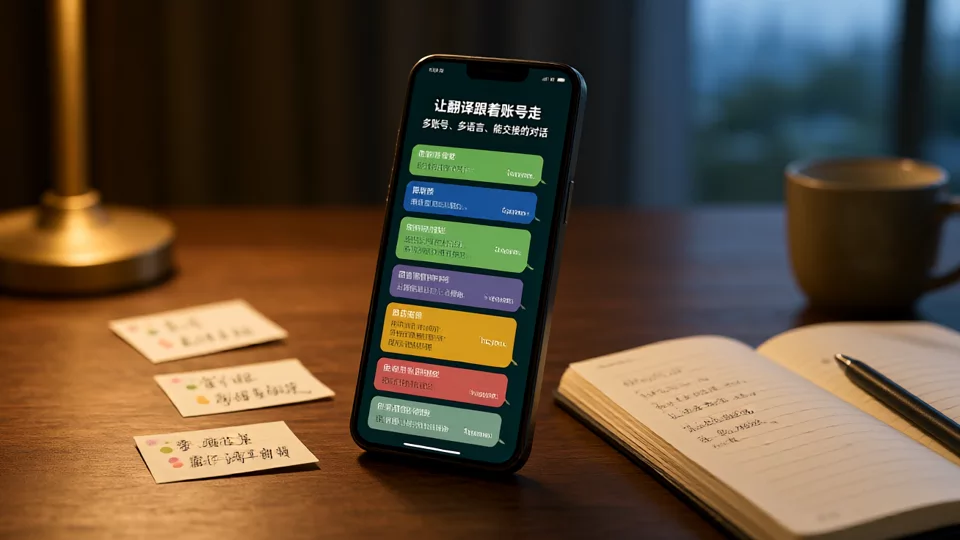
Messages pop up simultaneously in three Telegram accounts, and customers ask about the specifications of the same product in English, Arabic, and Indonesian respectively. The operator understands every sentence but replies from the wrong account when switching windows; after a colleague takes over on shift handover, the same passage is translated again. The bottlenecks cross-border teams encounter in tg real-time translation chat are usually not about whether a single sentence translation reads smoothly, but about account ownership, customer language preferences, and next actions not moving along with the conversation.
Below, we break it down according to the real flow of a conversation: how to onboard accounts, how to verify translations, how to determine the reply language, how to convert inquiries into followable tasks, and how to accept the three-day pilot. Each step provides verifiable fields rather than starting with a list of tool names.
First locate the breakdown points: three places where Telegram multi-account conversations are usually lost
The first is account ownership. Once all messages are aggregated into one window, customers may have the same nickname and similar avatars, and the team often does not even notice when it replies from the wrong account. The second is language preference. The customer uses English this time, Arabic last time, and mixes in two sentences of Indonesian the third time; the person taking over guesses from memory, and a wrong guess means explaining everything again.
The third is the next action. When a customer says, “I'll first confirm with my partner,” if this sentence does not become a task with an owner and a time point, no one will bring it up again the next day. Pick three cross-language conversations from yesterday and try to answer without looking at the chat history: Which account did this come from? What language is the customer used to? Who will do what next? If you cannot answer any one of these, fix the process first, then connect the tools.
Account onboarding and ownership: first distinguish multiple accounts, then discuss real-time translation
Before onboarding, register accounts as assets first; this takes priority over choosing which tools to use. Once there are many accounts, most confusion comes from “no one can clearly say who holds which account and which area it is responsible for.”
- Assign a unique identifier to each account.For example, "TG-01 Indonesia After-Sales" — the identifier should make the purpose and primary owner obvious at a glance, rather than using only the username that customers see.
- Keep the source account visible in the aggregated view.Every message must be traceable to a specific account and a specific customer; a view that shows only customer nicknames will eventually cause problems.
- Designate a primary owner and a backup.Write down who takes over when the primary owner is on leave and which conversations they cover in the shift schedule — don't ask in a group chat at the last minute.
- Record the customer's source and preferred language.Use the source channel (advertising, groups, referrals from existing customers) and the language the customer used in their three most recent interactions as the basis for the language of subsequent replies.
Get these items right, and aggregated translation becomes meaningful: translations follow the account, rather than messages from all accounts blending into one unowned inbox. For a complete breakdown of multi-account onboarding and message aggregation, seeHow to implement multi-account customer communication: practical key points for a Telegram customer service system and message aggregation.

Is tg real-time translation chat usable? Five checkpoints
When trialing a tool, use the five points below as a checklist; this is closer to a real shift than just checking whether one translated sentence reads smoothly.
- Bidirectional, with the original text available for comparison.Both customer-sent and team-sent messages must be translatable, with the original text always available for reference; if only translations are kept, verifying the customer's exact words later will be difficult.
- Translations remain linked to the account and customer.After switching accounts, historical translations can still be matched to the original account and contact.
- Mixed-language handling.When a single message contains both English and Indonesian, or Arabic mixed with specification parameters, can it still be understood rather than skipped entirely?
- Allow manual corrections.When a translation is wrong, it can be rewritten with an edit trail, so colleagues later know which sentence was manually adjusted.
- Can it be directly adopted?After translation, can it go directly into a customer record or task, rather than being copied into another spreadsheet and organized again?
These five points do not make any accuracy commitment; they only answer “can this be used in real shifts?” If any one is missing, it will become amplified rework as accounts and staff increase.
Multilingual replies and handovers: turning “understanding” into “replying correctly”
Determine the reply language in order: first check what language the customer's most recent message is in, then check the customer's historical preference on this account, and only then use the team's default language. When the customer switches languages on their own, go by the latest message—there is no need to insist that “we have always used English.”
- Mixed-language messages.Reply with the core conclusion in the customer's primary language, but keep proper nouns and specifications in the original language so model numbers do not mismatch after translation.
- Write three lines before handover.Customer language, confirmed information, next action, and timing. If you cannot write these three lines, it means this round of communication is not yet ready for handover.
- After the shift handover, read the three lines first, then look at the messages.Do not start again from the top of the chat history; going through it again is just repeated translation.
The role of two-way translation in this chain is to connect “understanding” with “replying correctly”; for specific methods, refer toHow to use 007 two-way translation in cross-border customer communication? Practical points for social platform aggregation translation.
telegram lead generation tickets: the minimum fields for converting an inquiry into a task
An inquiry generated by lead generation is not the same as a ticket. Create a ticket only when an inquiry needs to be carried forward across shifts, people, or accounts; if a question like “Do you still have stock?” is answered on the spot and closed, forcing a ticket to be created will only turn the list into a checklist that no one reads.
Signals that justify conversion into a ticket include: the customer provides specific specifications or quantities, requests a quote and lead time, needs to be transferred to another role (logistics, finance, after-sales), or promises to reply later but has not responded by the end of the day.
- Source account, used to trace which channel and which account is handling it.
- Customer identifier: nickname plus unique ID or phone number, used to identify duplicate inquiries across accounts.
- Language preference, which the person taking over uses to decide which language to reply in.
- Requirement summary: state the specifications and quantity clearly in one sentence; do not copy the entire chat.
- Next action: write an executable action such as “send a quote” or “confirm shipping costs,” not “follow up.”
- Owner and deadline: a task without a time point is equivalent to no task.
If any one of these seven fields is missing, the person taking over has to go back to the chat history and search again, which means redoing the translation and judgment. When encountering duplicate inquiries across accounts, first check by customer identifier whether an existing ticket is already in progress; if so, merge it in and note the new source account, and do not open a new one. For more on how tickets connect messages and customer management, continue readingHow a ticket system connects messages and customer management in multi-account communication scenarios on social platforms.

How to use terms like “walrus two-way chat translation software”: break down the task first, then examine the tool’s boundaries.
“Walrus two-way chat translation software” is a search entry point, not the name of this site’s product. People searching this type of term actually need to solve four things: whether messages from multiple accounts can be gathered into one view, whether translation is two-way and can be compared against the original text, whether customer information can be retained, and whether handovers are recorded. When selecting a tool, checking these four items one by one is more reliable than comparing feature lists.
SKY SCRM’s public information describes an aggregated translation and customer management system that supports multi-account management across global social platforms, multilingual communication, AI translation, and customer management. The specific Telegram integration method, supported scope, and translation performance need to be verified during a trial against the five judgment points above; this article makes no performance promises.
Three-day pilot: use four metrics to judge whether it is truly implemented
Do not accept it based on “it feels handy.” Pick two to three accounts and two to three frontline operations staff, run it for three days, record four metrics using the same definitions, and then look at the trend.
| Metric | How to record it | What it tells you |
|---|---|---|
| Number of account attribution errors | Log the account once each time an error occurs | If it hasn't dropped after three days, it's most likely because account labeling and views weren't set up properly |
| Number of follow-ups still needed after translation | Number of times you have to go back to the customer because the translation is unclear | Whether they cluster around mixed-language content or specialized terminology determines which area to fix first |
| Handoff field completeness rate | Proportion of sampled tickets with all seven fields complete | If it is below the team's agreed threshold, simplify the fields or make key items required |
| Number of retranslations after handoff | Number of times the person taking over retranslates the same passage | If it is high, it means the three-line handoff note was not written, or no one read it after it was written |
After three days, decide based on the trend: if two or more items have not improved, fix the process first (account labeling, required fields, three-line handoff), then consider changing tools; if most metrics are improving, extend the same measurement approach to more accounts, and don't switch everything at once
Frequently asked questions
Do you always need to create a ticket first for multi-account Telegram communication?
Not necessarily. Inquiries you can answer on the spot are faster to reply to directly; creating a ticket actually slows things down. The criterion is whether the matter needs to be carried forward across shifts, people, or accounts — only then should it be turned into a ticket.
Does real-time chat translation lose the customer's original wording?
It depends on whether the tool keeps the original text for comparison. Make “the original text is always available for review” a must-have in your selection criteria, and require manual corrections to be logged, so you avoid a situation where only the translation remains and it cannot be verified afterward.
How should repeat inquiries from lead-generation customers across accounts be merged?
First check by customer identifier whether an open task already exists; if so, merge it into the original ticket and note the new source account and time — do not create a duplicate ticket. After merging, update the language preference and next action so the person taking over does not have to ask again.
What breaks if you only install a translation tool and do not keep customer records?
Handovers and follow-up. You can understand the translation, but no one knows who is responsible, where the last conversation left off, or what was promised to the customer; as accounts multiply, the same customer gets the same question answered again and again.