




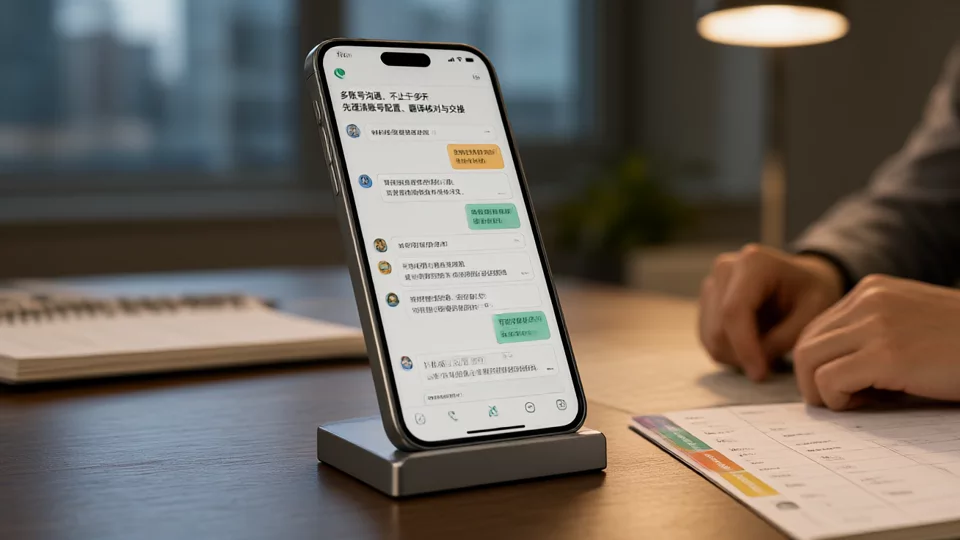
Installing a multi-instance tool and putting three or four accounts online at the same time does not mean the team can handle customers in parallel. What usually makes multi-account communication spin out of control is not the number of accounts, but the failure to define three things after a message comes in: which account this message belongs to, which language the customer is speaking, and where the previous colleague left off.ws software multi-instanceIt is only the entry point; the configuration after the entry point is what determines whether this workflow can actually be used.
This article does not provide an installation package, nor does it promise ban prevention, unlimited multi-instance, or any specific efficiency improvement; it only clearly lists the configuration and collaboration rules that should be defined before running multiple instances. Information about SKY SCRM in this article is stated only according to the publicly available business description on this site: it is an aggregated translation and customer management system that supports multi-account management, multilingual communication, AI translation, and customer management on global social platforms.
First distinguish: does the team need “multi-instance,” or collaborative multi-account communication?
Search ws software multi-instance people, most want to first solve “logging into multiple accounts at the same time”; search ins software multi-instance people have similar needs. Both search tasks stop at the login layer, while the team’s real difficulty comes after login: whether message aggregation, language understanding, and customer records can connect into the same workflow.
The test is straightforward: if a colleague takes leave tomorrow, can the person taking over understand within five minutes what this customer has asked, what language they use, and what the next step should be? If not, it means you only have “multi-instance” on hand, not collaborative multi-account communication.
Before opening multiple instances, define account ownership: who is responsible for which account, and which account to use in which scenario
Unclear account ownership is the most common source of rework in multi-account reception. Before opening accounts, write the following items into the team’s configuration table.
- Primary owner and backup: Each account should have at least one primary owner and one designated backup who can step in, avoiding a situation where only one person can take over the account.
- Usage boundaries: Specify which type of customers or which market this account mainly serves, to reduce the same lead being followed up repeatedly by two accounts.
- Login and device management: Clarify who maintains the login status and where to log in, to avoid multiple people each logging into the same account and causing message attribution confusion.
- Service hours: Teams across time zones need to create a duty roster and agree on how messages that arrive outside duty hours are marked.
- Platform responsibilities: Whether WhatsApp and Instagram are handled by the same person determines the complexity of subsequent message aggregation.
Writing account ownership into a one-page configuration table is more effective than repeatedly reminding people in a group chat to “be careful not to reply from the wrong account,” and new colleagues can refer to it directly when they join.
The judgment logic for these items is consistent with the selection criteria for multi-account management tools, so you can refer tocriteria for global social platform multi-account managementfor the checklist approach.
ws real-time translation needs to be tied to the conversation, rather than just adding a translation toggle.
ws real-time translationThe value of ws real-time translation lies not in the translated text itself, but in whether the translation stays next to the right account, the right customer, and the right source text at all times. You can check it in four steps during configuration.
- Incoming messages: Confirm that messages first enter the aggregated view instead of being scattered across multiple windows waiting to be found.
- Account identification: Confirm that each message carries an account tag, so when replying you can tell which account it was sent from.
- Translation comprehension: Confirm that the original text and translation coexist; the translation is for quick understanding, while the original is for verifying numbers, model numbers, and addresses.
- Reply attribution: Confirm that reply actions are bound to the original conversation, so there is no case of 'viewing Account A but replying from Account B'.
Real-time translation in Instagram direct messages encounters similar issues; you can refer toPractical approach to real-time translation chat on Instagram, and the checking order for both can largely be borrowed from each other.

Fields and responsibility rules that must be carried over during collaboration handoffs
In multi-account scenarios, losing context during handovers often causes greater losses than slow replies. Before a conversation is transferred to a colleague, at least the fields in the table below must be passed along.
| Field | Recorded content | Common consequences if missing |
|---|---|---|
| Account ownership | Which account the message comes from | Replying from the wrong account, the customer receives two conflicting messages |
| Language preference | The customer's preferred language and form of address | After a handover to another staff member, re-testing the language slows down replies |
| Original text and translation | The original messages and translations from both parties | After model numbers, addresses, and amounts are overwritten by the translation, they can no longer be verified |
| Current request | The problem the customer needs to solve right now | The person taking over asks again, and the customer repeats the description |
| Next step | Owner and estimated follow-up time | The conversation stalls midway with no one pushing it forward |
In terms of division of responsibilities, customer service is responsible for completing replies within the original conversation and filling in missing fields; supervisors are responsible for determining ownership across accounts and merging records for the same customer; operations is responsible for account-level usage boundaries and consolidating messaging guidelines. For when a conversation should be converted into a ticket and what context should be carried over when transferring a ticket, you can refer toHow a ticketing system connects messages with customer managementSet it up step by step.

Start with a small-scale pilot: verify whether the multi-account setup truly supports collaboration.
Don't roll out all accounts at once. Start with 2 to 3 accounts over one to two weeks as a pilot, and check each item in the table below; if any item cannot be met, fix the configuration first instead of adding more accounts.
- If the same customer asks through two accounts, can the team identify them as the same person and merge the context?
- Is the original text always kept next to the translation so key information can be checked?
- After handing over to a colleague, does the colleague still need to ask the customer again?
- When reviewing a closed conversation, can you directly see the account, language, request, and outcome?
The point of a pilot is to expose configuration issues within a small scope. Adding more accounts will not automatically solve ownership and handover problems; it will only amplify the same problem across more conversations.
FAQ
Does multi-account just mean opening a few more browser or client windows?
In terms of quantity, you can think of it that way, but opening multiple windows only solves simultaneous login. Teams also need three links: account ownership, translation binding, and handover records; otherwise, the more windows there are, the higher the risk of replying from the wrong account.
When multiple accounts are online at the same time, how do you avoid replying from the wrong account?
Make each message carry an account tag in the aggregated view, lock reply actions to the original conversation, and make 'account ownership' a fixed item in the handover fields. Rather than reminding colleagues to 'look carefully,' making ownership a structured field is more reliable.
Must ws real-time translation always retain the original text?
It is recommended to retain it. The translation is used for quick understanding, while the original text is used to verify content that can easily become ambiguous in translation, such as product models, addresses, and amounts; it also allows traceability when discrepancies arise.
Are the configuration priorities the same for Instagram multi-account and WhatsApp multi-account?
Account ownership, translation binding, and handover fields are common to all three; the difference lies in each platform's message format and interaction method. During configuration, simply check each platform's respective reception hours and message entry points separately.