




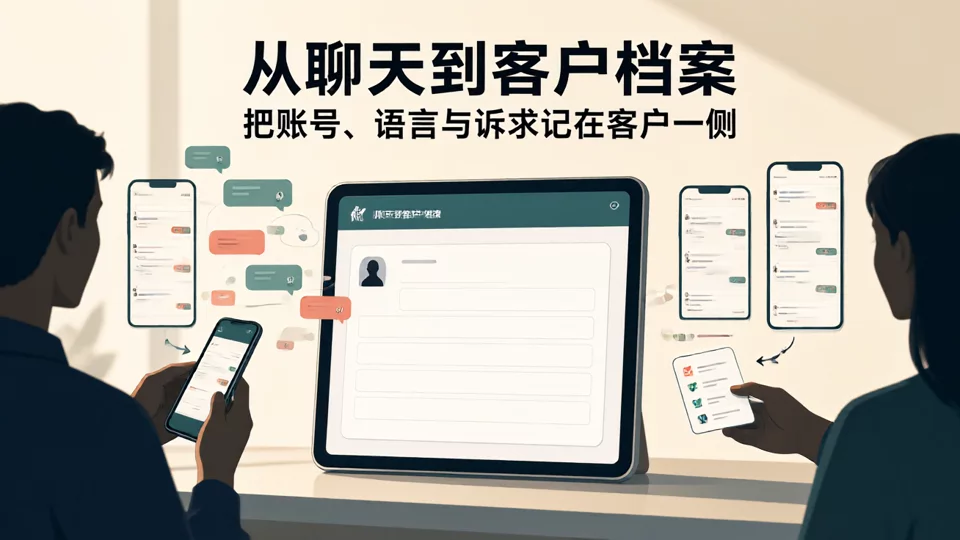
At the moment prospecting ends, the customer has not actually become "data" yet
In the first hour after a friend request is accepted, the team usually has only an avatar, a greeting, and one chat record on hand. When follow-up is attempted two or three days later, who added them, what language the customer speaks, and which batch they came from often require digging back and forth across several chat windows and a shared spreadsheet.
The problem is not a missing tool. Third-party prospecting tools such as KT smart prospecting address reach and friend-adding, turning strangers into contacts who can be conversed with; a management system addresses whether these contacts can be queried, understood, and handed off. What is missing between the two is a field-transfer chain—when the acquisition action ends, the information carrying context does not enter the record together with the person. This article does not verify or evaluate the features of any third-party prospecting tool; it discusses only the stage "after the person has been added."
After adding a friend, the four pieces of information most likely to evaporate
- Account ownership: which social media account the customer added through. When multiple accounts operate in parallel, this item is lost fastest, replies easily use the wrong identity, and handoffs cannot clearly state who should follow up on this lead.
- Language preference: which language the customer prefers for communication. This often exists only in one agent's translation settings, and whoever takes over has to figure it out all over again.
- Source batch : which follow-gaining action and which entry point this batch of contacts came from. Without a batch, it becomes impossible later to tell which group of people is worth prioritizing.
- Initial request : what the customer asked in their first message. This usually stays in the chat window and gets omitted when converted into a task, leaving whoever takes over to ask again from scratch.
Together, these four items form the minimum context of a customer profile. Miss one, and you ask one extra question during follow-up; lose all four, and the customer degrades into just a nickname.
From chat window to customer profile: three checkpoints every conversation must pass through
- Build the profile at first contact.Record the four fields as soon as the friend request is accepted and the first message comes in, when the context is most complete. Do not wait until "intent emerges" to create the profile, because by then account ownership and source batch are often already unclear. The agent handling the conversation can create the profile; leave fields blank and mark them as pending if missing, and do not fill them in from impression.
- Complete it during the conversation.Nickname, time zone, intended product, and available contact details should be added item by item as the conversation naturally progresses. There is no requirement to fill everything in at once, but the profile should be more complete after each round of communication than the previous one. When multiple accounts receive inquiries in different languages at the same time, you can refer toHow to use the Walrus Translation System: Multilingual Customer Service Translation and Social Platform Communication Scenario AnalysisThe practice of retaining account ownership and handover context.
- Once the threshold is reached, convert it into an assignable task.When a clear quote request, sample request, or scheduled follow-up time appears, convert the conversation into a task and let the four fields travel with the task. To see which fields a conversation-to-task conversion needs to carry, refer toIn multi-account communication scenarios on social platforms, how a ticketing system links messages with customer managementthe breakdown in.

Language preference and account ownership: why they must follow the customer
Whether language preference is recorded on the customer profile or left in the agent's translation settings only becomes apparent at the moment of handover. Take instagram real-time translation chat as an example: a customer once asked about pricing in English, and the agent understood and replied via real-time translation. The next day, on a shift change, a new agent opens the conversation. If the profile clearly states that the customer habitually uses English, the reply language does not need to be probed again; if it is not stated, the agent must either translate the history again or first ask a question in Chinese, and the rhythm breaks right there.
The same applies to account ownership. When using line multi-instance software to handle multiple accounts in parallel, the same customer may appear from different entry points. If the profile layer records only the customer name and not "owning account + source batch," the same person will be treated as two new leads, with duplicate records, duplicate quotes, and even two agents following up at the same time. For how account ownership and language preference can be preserved during multi-account parallelism, refer toHow to use Walrus multi-instance software: multi-account parallel operations and communication management ideas.
SKY SCRM is positioned to bring aggregated translation and customer management together in one place: when messages from multiple accounts come in, translation and customer records are not separated; account ownership and language preferences are attached to the customer side, rather than following a particular agent's working status. When someone else takes over, they see the same profile with context.

Minimum field standards for customer profiles
The six fields below can be used directly as profile creation checklist items; the first three are captured at first contact, and the last two are updated at the end of each communication round.
| Field | Recording timing | Consequence if missing |
|---|---|---|
| Account ownership | First-contact profile creation | Replies use the wrong identity, and the lead source cannot be confirmed during handover |
| Source batch | Create a record at first contact | Cannot tell which batch of leads is worth prioritizing |
| Language preference | At first contact or after the first round of conversation | When someone else takes over, the reply language must be determined again |
| Initial request | Create a record at first contact | The person taking over asks everything again from the start, which degrades the customer experience |
| Next action | At the end of each conversation | Follow-up breaks down at "we talked but reached no conclusion" |
| Last interaction time | At the end of each interaction | Unable to tell which customers are cooling off |
Use a three-day small-scale validation to confirm whether the pipeline actually works
Don't roll it out to everyone right away. Pick one new customer acquisition batch and two to three accounts, observe continuously for three days, and look at only four things:
- Profile creation rate:Of the newly arrived contacts, how many had a profile created on the day of first contact. If it is below expectations, it means profile creation is being treated as something to "catch up on when there's time."
- Field completion rate:On average, how many of the four core fields are filled in. If account ownership and source batch are always empty, the problem is that there is no shared definition connecting acquisition results and profiles.
- Handover cost:Have another agent take over three conversations and see whether they need to ask again about language and source. If they do, the fields are being recorded on the agent side rather than the customer side.
- Duplicate profiles:Whether the same customer is profiled twice when appearing across accounts. For how to handle this type of duplication, refer toHow to organize a Telegram lead-generation ticket workflow: a practical checklist from lead assignment to follow-up recordsthe notes on account ownership and missing source batches.
When you find a breakpoint, prioritize filling in the first-touch record creation step rather than building reports first. If the first touch doesn't capture fields, every later step can only be filled in from memory.
FAQ
Do all added contacts need a profile record?
Not necessarily. We recommend setting a minimum threshold—for example, create a record once there has been one substantive reply (asking about price, specifications, or logistics); if someone only says hello and gets no response, just keep them in the conversation list without taking up profile capacity.
If the conversation stops after just a few messages, should I create a record?
It depends on whether reusable information was left. If the customer mentioned an intended product or their market—even in just one sentence—it's worth creating a lightweight record; the fields can be limited to account ownership, language preference, and initial request.
If the same customer appears under two accounts, does that count as one or two?
Count them as one customer, but keep multiple ownership records by account. For merging, use contact details the customer provided or clear identity information as the criteria; don't rely solely on similar nicknames. For information retention standards after a conversation ends, refer toHow 海译通 tickets support customer follow-up after multi-account social conversations.
Should the translation be stored in the archive as well?
Store the original text as the primary record, and keep the translation as an auxiliary view. The original text is the evidence of what the customer actually said, while the translation changes as translations are updated; treating the translation as the sole record makes later verification prone to distortion.
In multi-account scenarios, at which layer is account ownership recorded?
Record it on the relationship between the customer and the account, not on the agent. Agents change shifts and get reassigned to different groups, whereas the relationship between an account and a customer is relatively stable, so during shift handovers there is no need to verbally add "this customer was added by me using which account".