




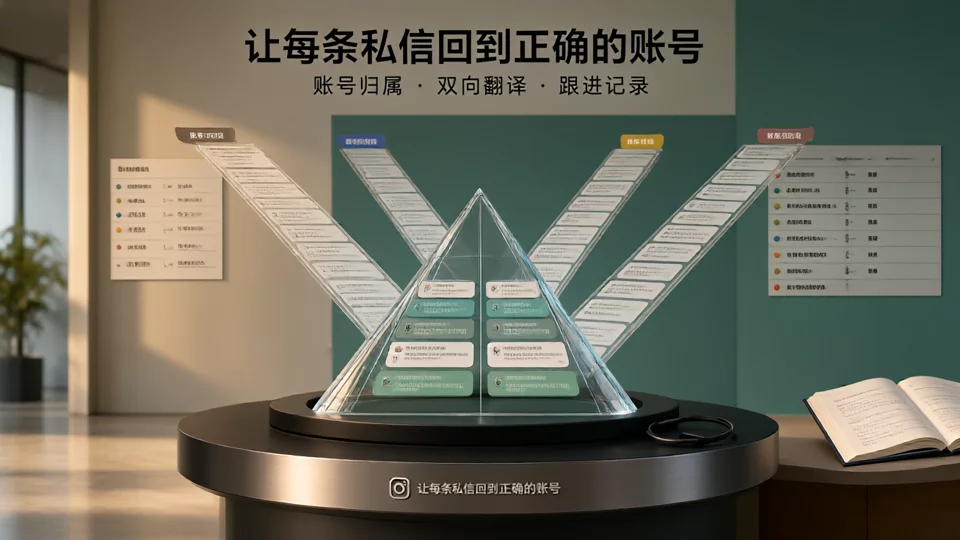
Three Instagram accounts light up with new messages at the same time, and customers ask about the delivery time of the same product in English, Arabic, and Indonesian. The agent understands all three languages, yet when replying sends account A's quote into account B's conversation. Mistakes like this have little to do with translation accuracy; the key is whether an incoming message always stays attached to the right account, the right customer, and the right next action.
So the answer to “how do you implement real-time translation chat on Instagram” is not installing a plugin, but linking several actions together: account connection, message aggregation, two-way translation, reply attribution, and one more step — follow-up records. Below, this chain is broken down step by step, with actionable criteria for each step and an explanation of what shows up when it cannot be done.
First, break “real-time translation chat on Instagram” down into four implementation paths
Real-time translation in Instagram DMs currently comes in four common approaches, and the problems they solve are not on the same level. First confirm which level you are on, then decide how much to invest.
| Approach | What it can do | Main gaps in multi-account scenarios |
|---|---|---|
| Built-in translation in the official client | Understand a single message with one click, without switching windows | Translations are not tied to accounts or customers, so they cannot be handed over |
| Full-page translation in the browser | Replaces the entire interface text with Chinese | Translation is detached from the conversation, so in multi-person collaboration there is no way to mark who replied to which message |
| Integrate a translation API yourself | Customizable terminology and translations | Account connection, message aggregation, and reply attribution all have to be handled by the team itself |
| Aggregated translation platform | Unified access for multiple accounts, message aggregation, two-way translation, and customer records in one place | Depends on whether the platform supports the corresponding account type, and needs to be checked item by item during the trial |
According to the information on this site, SKY SCRM is positioned as an aggregated translation and customer management system that supports multi-account management and multilingual communication across global social platforms; for specifics such as Instagram account types, the number of accounts that can be connected, and the languages available for translation, please refer to the official documentation and your own trial results — this article does not speculate.
When messages come in on three accounts at the same time, what gets dropped first is usually not the translation
Lay out a single conversation and you can see that from the moment a message arrives to the point where it can be handed over, there are five stages: account connection, message aggregation, two-way translation, reply ownership, and follow-up records. The first two determine who the message belongs to; the middle one determines whether it can be understood; the last two determine whether the next step still exists. When multiple accounts run in parallel, the stages most likely to break are the 1st, 4th, and 5th, because they do not produce any visible error. A mistranslation is noticed by the agent on the spot, whereas replying from the wrong account often only comes to light when the customer asks you why you sent someone else's price.

For a complete breakdown of multilingual translation on social platforms, see"How to Use the Walrus Translation System: Multilingual Customer Service Translation and Social Platform Communication Scenarios Explained", which walks through a real conversation and covers the four parts — connection, aggregation, translation, and reply — in more detail.
Why Instagram DMs are not suited to being propped up by browser translation
Whole-page browser translation works on the interface text layer: it swaps the sentences on screen for Chinese, but the translation is not tied to a particular account or a particular customer, and it leaves no record of "who replied with this sentence, and in what language." For one person on a single account, where the goal is mainly to understand, it is entirely sufficient; once you move into multi-account reception and shift handovers, the same passage becomes two unrelated temporary results in two people's eyes.
The test is straightforward: if your team has ever said "I thought you were handling this one" or "where did we leave off last time," it means translation needs to live inside a conversation container that carries account ownership, rather than continuing to rely on whole-page translation. For the dimensions to check against on similar platforms, see"How to Choose Facebook Translation Software: A Practical Checklist for Multi-Account Management and Customer Communication", and this set of dimensions is broadly applicable to Instagram.
Four implementation steps: from account onboarding to reply ownership
Carry out the four steps in order, and each step addresses only one issue. Skipping a step will make the checks in the next step meaningless.
- Establish a fixed mapping between the account list and the responsible owners.List all Instagram accounts in a table, clearly stating each account's purpose (main account, regional account, customer service account) and primary owner. A typical sign of skipping this step is that when a message comes in, the first question asked is 'Who manages this account?'
- Ensure that messages from the same account are not split apart.The purpose of aggregation is to view messages from multiple accounts in one place, but each account's conversation thread must remain complete. If, after aggregation, only the latest message is visible, then previous quotes, addresses, and commitments all have to be dug out of the chat history.
- Distinguish between 'understanding it' and 'being able to use it directly'.The former means understanding what the customer is saying; the latter means producing a reply that can be sent directly. Product models, specifications, amounts, and delivery schedules are most likely to become distorted between these two stages, requiring a glossary or manual confirmation; machine translation must not be assumed to be ready for external sending by default.
- Before replying, confirm all three at once: the account from which the reply is sent, the language used, and the next action.If any one of the three is wrong, the customer receives a message that requires re-explanation. This is alsoHow a Ticketing System Connects Messages and Customer Management in Multi-Account Communication on Social Platformsthe core: the fields that must be carried over when a conversation becomes a task.
What a conversation must retain after translation to qualify as a followable customer
When a conversation ends, at least five pieces of information must remain for it to be followable: the source account, the customer's language preference, the original text and translation, the current conclusion, and the next action and owner. If any one is missing, the next contact will have to rebuild the context from scratch.

Language preference is the easiest to miss, and the consequences are the most direct: the customer asks in Spanish, the team communicates internally in Chinese, and the reply goes out in English out of habit, so the next contact requires deciding again which language to use. The original text and translation must be kept as a pair; keeping only the translation removes the basis for verification when a quotation is reviewed. The decision on merging the same customer when they appear repeatedly across accounts is covered in“Message Aggregation and Translation When Running Multiple twitter Accounts: A Practical Approach to Multi-Account Customer Service Collaboration”there is a similar approach: the platform changes, but the fields stay the same.
Search term boundaries: KT智能拓客, line多开软件, and Instagram real-time translation chat are not the same thing
These three terms correspond to three different types of tasks.KT智能拓客 focuses on lead acquisition, while line多开软件 focuses on parallel login across multiple accounts; this article does not verify or evaluate the features or results of either. The reason they are often lumped together is that a search for “multiple accounts” surfaces login, translation, and customer management results at the same time. According to the information on this site, SKY SCRM is positioned as aggregated translation and customer management, supporting multi-account management and multilingual communication across global social platforms. It does not treat the capabilities of third-party tools as features of this site, nor does it infer product capabilities that the information does not describe. For the boundary between parallel login and translation-based communication, see“How to Use 海象多开软件: Approaches to Multi-Account Parallel Operations and Communication Management”.
Three-day small-scale validation: can this approach work in your team
No need to roll it out to everyone. With two Instagram accounts, three customer languages, and ten real historical messages, you can see whether this approach holds up.
- Day one, onboarding and ownership.Connect the two accounts according to the checklist in Step 1, with different people handling each. Checkpoint: when a message comes in, can the person handling it say without hesitation which account it belongs to?
- The second day: translation and replies.Pick five messages that contain model numbers, amounts, or delivery dates and run them through the full process. Checkpoint: is the account correct, is the language correct, and are there any sentences that must be rewritten manually?
- On the third day, handover and follow-up.Have another colleague take over three of them, looking only at the records and not the original chat. Checkpoint: does he need to re-translate, and can he state the next action?
If any one day's checkpoint fails during the three days, the problem is usually not in the translation step but in account ownership or missing fields. To extend the validation into selection decisions, see"Social Platform Translation and Customer Management Selection: What Else to Consider Beyond the 海译通 Website".
FAQ
Is the translation built into the official Instagram client enough?
It is enough for understanding a single message. It does not keep translations tied to accounts; when multiple people collaborate, it cannot indicate who replied to which message, nor can it bring the results into customer records. Therefore, it is not suitable as the sole means of customer reception across multiple accounts.
Will translation latency slow down the pace of replies?
What usually slows down the pace is not the time translation itself takes, but the sequence of actions after translating: switching windows, copying and pasting, and then finding the right account. Putting translation where the conversation is saves the switching cost.
If the same customer asks with two accounts, how should you handle it?
First use the nickname, the product they ask about, and the order information they mention to judge whether it is the same person. After confirming, merge them in the customer record while keeping both source accounts. Do not reply with one set of answers under each account; otherwise, it is easy to end up with inconsistent quotes.
If you only operate one Instagram account, do you still need aggregation?
The number of accounts is not the basis for deciding; the number of people involved in replying is. With one person and one account, putting translation and records in one place is already enough; once a second person takes over, you need a structure that can indicate account ownership and next actions.
What is the fallback when machine translation goes wrong?
List model, specifications, amount, and delivery date as fields that must be confirmed manually. When these appear in a translation, do not send it directly; at the same time, keep the original text in the record so you can later check where the discrepancy occurred.