




Start with a Real Conversation: The Problem Is Often Not “Whether There Is a Ticket”
On Monday morning, the same customer asked about shipping costs in English yesterday on Page A, and today on Page B switched to Spanish to follow up on the same order number. Customer service agents switch back and forth among three chat windows and one shared spreadsheet, and no one can say clearly which message has been replied to and which is still waiting for a quote. The team’s first reaction is usually “should we switch to a different ticketing system,” but the real loss happens at the moment a conversation is converted into a task: account ownership, language preference, and next action all drop off together.
Therefore, selection should not start with a feature list, but with the complete flow of a conversation: how it is connected, whether it can be understood, when it is converted into a task, who replies, and what is left behind during handover. The following criteria can all be checked item by item during the trial period, rather than relying on a demo.
Separate the Three Types of Systems First: What Facebook Customer Service Systems, Ticketing Systems, and Multi-Account Management Each Handle
Confusing the three most commonly results in buying a ticketing system but still having to look for customers in chat windows, or treating “being able to log in to multiple accounts at the same time” as customer service capability. They handle different stages respectively, and most teams need a combination, not a replacement.
| Capability Type | Mainly Solves | Typically not responsible for | What to check first in a trial |
|---|---|---|---|
| Facebook customer service system | Receive Page direct messages and comments, aggregate conversations, translate for understanding, and organize replies | Cross-department task routing and long-term tracking | Whether messages carry the source account, and whether translations can be used directly in replies |
| Ticketing system | Assignment, status, time limits, and traceability after a conversation is converted into a task | Platform message integration and language processing | How many fields are carried over when creating a ticket from a conversation |
| Multi-account management (multiple accounts open at once) | Manage multiple accounts in one place and reduce back-and-forth switching | Customer context, translation, and follow-up records | After switching accounts, do the records still belong to that customer |
| Aggregated translation plus customer management | Layer translation, customer profiles, and follow-up records on top of aggregated conversations | Replace complex approval flows and project management | Whether translation, account ownership, and customer information are in the same view |
First criterion: after messages are aggregated, do account ownership and the customer's language preference still follow the customer
Pulling DMs into one interface is only the first step. What needs to be confirmed is whether each message indicates its source platform and specific account, whether the customer has a relatively stable language marker, and whether the historical conversation remains complete after someone else takes over. Without account ownership, a reply may be sent from Page B while the customer is waiting for after-sales service from Page A; without a language marker, every handover requires deciding anew which language to use.
SKY SCRM's publicly stated business positioning is aggregated translation and customer management, covering multi-account management, multilingual communication, AI translation, and customer management across global social platforms. Which platforms are specifically supported and how accounts are connected should be based on the current descriptions on the official website and client, and marketing language should not be treated directly as acceptance conclusions. For more detailed translation-related check items, refer toHow to choose FB cross-border translation software: a practical checklist for multi-account customer communication scenarios.
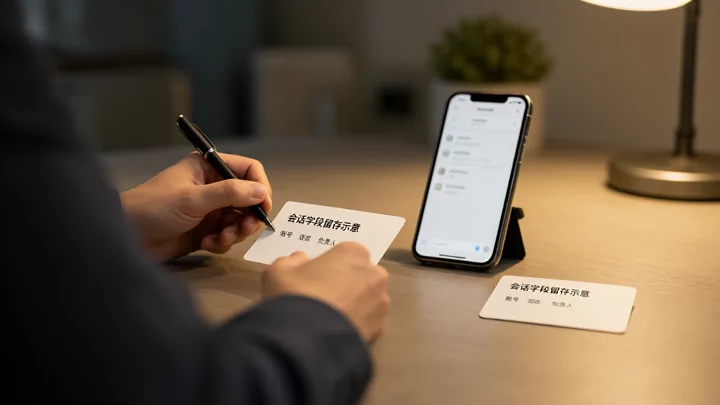
Second criterion: the six fields that must be carried over when a conversation is converted into a ticket
More fields are not necessarily better, but if any one of the following six items is missing, the handover will break down somewhere:
- Source account: the platform plus the specific page or account. Without it, a reply may be sent from the wrong account, and the customer will see a different history.
- Customer identifier and contact information: Customers often use different nicknames on different platforms, so an identifier that runs across them is needed; otherwise, the same person will be treated as two new customers on two pages.
- Original language and reply language: record the language the customer actually uses and the confirmed reply language. Without it, the person taking over will either have to translate again or use the wrong language.
- Issue type: categories such as quotation, logistics, after-sales, and complaints determine who it is assigned to. Writing only “inquiry” is equivalent to having no category.
- Owner and backup:轮班团队必须能够看出当前由谁处理,以及在休假期间由谁接手。
- 下一步行动与截止时间:明确说明是“等待客户补充订单号”,还是“今天内给出报价”;否则任务状态会一直停留在“处理中”。
如何判断回复效率:看三个损耗点,而不是看翻译按钮的数量
工具中翻译入口多、界面漂亮,并不意味着回复更快。试用期内更值得记录的是三类损耗:
- 首次响应等待时间:从客户发出消息到第一次有人回应之间发生了什么。多账号团队常见的情况是,消息进入了聚合界面,但没有人认领。
- 重复翻译和重复询问:同一段内容被不同客服翻译了两遍,或者客户被迫在不同主页上把同一个问题讲两次。
- 交接后重新开始:换班或换人后,接手方重新翻译记录、重新判断语言,并重新询问一遍需求。
记录方式不必复杂:在三天内各挑若干条会话,标出上述三类损耗出现的位置和次数,就能判断问题出在接入、翻译还是分配环节。这里不给出具体的提升比例;你自己记录下来的位置,比任何宣传数字都更有用。
Trial acceptance: run through one full cycle with three types of real conversations
The smoothness of a demo environment often comes from prepared samples. For acceptance, choose the conversations yourself and go through all three types:
- General inquiry: Ask in the customer's actual language, check whether the translation is readable, whether the reply language is correct, and whether the customer record retains the account and language after the conversation ends.
- Complaint escalation: Turn a direct message from one account into a task that someone else needs to handle; check whether all six fields can be carried over and whether the person taking over can continue the conversation without asking follow-up questions.
- Cross-language follow-up: A day later, contact the same customer from another account or another platform; check whether the system still recognizes that this is the same person and whether the previous language preference and conclusions are still there.

After all three types are completed, return to one question: do these records fall within the same customer view? If each link keeps its own separate record, the more tools that are connected, the higher the cost of stitching things together afterward. For selection criteria, you can continue to refer toSocial platform translation and customer management selection: what else to look at beyond the 海译通 official website; for teams that already have a ticketing system,Which teams is 独角兽工单 suitable for? Process differences and selection comparison with 海译通工单andHow 海译通工单 picks up customer follow-up after multi-account social conversationseach breaks the topic down from two angles, process differences and follow-up handling, which can serve as a reference when pairing them with your existing tools. Note that third-party ticketing tools differ in positioning from this site's business; neither 海译通工单 nor 独角兽工单 is a function described in SKY SCRM materials.
If you run multiple Facebook Pages at the same time, verify the boundaries separately
Teams running multiple Facebook Pages at the same time can apply the same set of criteria: whether account ownership, language preference, the person responsible and the next action all follow the customer. However, "multi-Page management" itself needs three things checked separately — whether Page messages and comments are supported, how many Pages can be connected and how login works, and whether conversation records still belong to the right account after switching Pages. Base these on the tool's current documentation and your own hands-on trial; do not accept verbal promises.
It is also important to distinguish this: multi-Page management is only an operational convenience, and does not mean platform rules can be circumvented. Account restrictions may come from a range of signals such as the login environment, operation frequency and content reports; there is no fixed relationship between any single factor and the action taken, and the specific reason should be based on the account notice and the platform's official policies. On the Facebook side, you can refer to Facebook Help Centerfor account and policy information. What SKY SCRM materials describe is aggregated multi-account management across social platforms, multilingual communication, AI translation and customer management; they do not cover unlimited account instances or circumventing platform enforcement.
FAQ
Does a small team of two or three people need ticketing workflows?
When the team is small, you don't need a full ticketing system, but you still need a fixed place to record things: who is handling the customer, what language the customer uses, and what the next step is. A shared spreadsheet can do this too; what matters is having consistent fields, not whether there is a ticket number.
When customers ask the same question repeatedly in comments and direct messages, which should be handled first?
Handle public comments first, because other potential customers can see them; then give a complete reply in the direct message and link both records to the same customer. The basis for this decision is visibility and privacy boundaries, not which one arrived first.
How do you judge during a trial period whether the translation is good enough?
Test it with the customer's own words, not with short sentences you wrote yourself. Pick real messages that contain model numbers, addresses, amounts, and colloquial abbreviations, and see whether the translation can directly support a reply and whether it is easy to compare against the original text to make corrections when something is translated incorrectly.
When running multiple Facebook Pages together, what is most easily missed during handovers?
The most common omissions are the source account and the reply language, which cause the person taking over to send from the wrong account or use the wrong language. The next most common omission is the "next action," which causes tasks to remain in progress for a long time. Making these items required is more effective than adding more fields.