





People who search for “fbsee counter” usually want to solve a very specific problem: whether engagement data on a Facebook Page can be counted, viewed, and even used to determine which customers are worth following up on. But search results often mix in translation tools, multi-account software, and customer service systems, making it easy to mistakenly assume that a counter naturally comes with customer management capabilities. Let us be clear first: the fbsee counter is not a feature described in SKY SCRM materials; this site does not provide this tool and does not evaluate its specific effectiveness. This article discusses how engagement statistics and customer communication can connect, as well as alternative approaches.
What Is the fbsee Counter? First Distinguish Tool Ownership and Purpose
Judging from the name, the fbsee counter is a third-party statistics tool, typically used to display certain public engagement metrics on a Facebook Page. This type of tool solves “seeing the numbers,” not “capturing customers.” It does not retain account ownership, record customers’ language preferences, or turn a comment or direct message into a follow-up task that can be handed over.
Therefore, when you see in search results at the same time海象翻译系统,Facebook translation softwareand counters, it is first necessary to clarify their respective task boundaries: counters focus on data display, translation software focuses on language understanding, and customer management focuses on conversation handling. The three may be used by the same team, but they should not be assumed to belong to the same product, nor should one party's feature descriptions be directly applied to the other party's product.
Which data should actually be reviewed in Facebook Page engagement statistics?
If the goal is to assess the quality of Page operations, a single number on a counter is often insufficient. A more practical approach is to break engagement data into several layers, each corresponding to a different business action:
- Exposure and reach: The number of people who see a post reflects the scope of content distribution, but it does not equal customer intent.
- Public engagement: The number and content of likes, comments, and shares can show which topics spark discussion, but commenters are not necessarily potential customers.
- Direct message inquiries: The number of people who move from public engagement to direct messages, and the types of questions they ask—these are the key signals that require customer service or operations staff to take over.
- Customers worth following up with: Contacts who leave contact details, clearly state their needs, and are willing to continue communicating; it is necessary to record the source account, language, and next action.
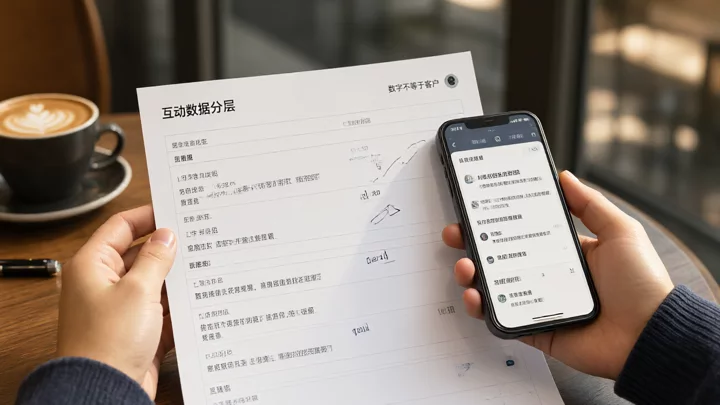
Only by viewing these layers separately do the counter numbers become meaningful. Looking only at the first layer makes it easy to mistake exposure for results; looking only at the second layer makes it easy to mistake onlookers for intent. What truly affects follow-up efficiency is whether the data from the third and fourth layers can be fully retained.
Why a counter alone cannot handle customer communication
The output of a counter is usually a summary number or a set of public metrics; it does not carry conversation context. When a customer comments in English on Page A and also asks about the same product in a Chinese private message on Page B, the counter may count the interactions on the two pages separately, but what the team sees during follow-up is two unrelated records. Account ownership, language preference, and historical communication content do not travel with the numbers.
In multi-account, multilingual scenarios, this problem is amplified. After customer service agents switch accounts, if they do not know which page a private message came from, which language the customer prefers, or where the previous round of communication ended, they can easily ask repeated questions or reply in the wrong language. A counter itself does not solve these problems; it is only responsible for making numbers visible, not for making conversations handover-ready.
This is also why many teams, after using a number of analytics tools, ultimately still have to return to the customer communication stage and rebuild their processes. Numbers can help you judge trends, but follow-up actions need to be anchored in specific conversations and specific customers.
An alternative approach: turn interaction data into customer information you can follow up on
Rather than repeatedly comparing counter numbers, it is better to take the thinking one step further: let interaction data enter the customer communication chain and retain account ownership, language preference, and next steps at the conversation level. SKY SCRM is positioned as aggregated translation and customer management, supporting multi-account management across global social platforms, multilingual communication, and AI translation; it is not a counter, but once customers move from public interactions to private-message inquiries, it can take over subsequent communication and follow-up.
Specifically, when a Facebook private message arrives, the team needs to know three things at the same time: which page the message came from, what language the customer uses, and what was left from the previous round of communication. The value of an aggregated translation tool lies in anchoring this information to the conversation rather than leaving it in someone's memory. Translation solves the problem of understanding, and customer management solves the handover problem; working together, they keep interaction data from stopping at a good-looking number.
If the team already uses counters to observe page performance, it can treat them as front-end signals and hand private-message inquiries and followable customers over to aggregated translation and customer management tools. This division of labor is clearer: counters tell you where the activity is, and communication tools tell you which activity is worth following up on. For follow-up connections after multi-account communication, refer toHow 海译通 work orders take over customer follow-up after multi-account social communicationfor its record-keeping approach.

Checklist for choosing an alternative tool
If you are looking for a solution beyond counters, the focus is not on finding a tool with more comprehensive numbers, but on finding a tool that connects interactions to communication. You can verify the following checkpoints one by one during a trial:
- Multi-account aggregation: Can you manage conversations from multiple Facebook Pages and other social platform accounts in the same tool, while preserving account ownership when switching?
- Two-way translation: When a customer sends a message in a foreign language, can you understand the original text and generate a reply-ready translation, with the translation retained alongside the original in the conversation?
- Customer information retention: Do language preference, source Page, and historical communication content follow the customer, rather than being scattered across inboxes of different accounts?
- Handover records: When follow-up is handed over to someone else, can they see the context of the previous round of communication and the next steps, avoiding repeated questions?
- Clear boundaries:Does the tool clearly state what it is responsible for and what it is not, rather than packaging statistics as customer management capabilities?
This checklist does not cover pricing or performance promises; it only helps you judge whether a tool can handle communication actions after interaction. For guidance on selecting multi-account translation tools, you can read furtherHow to Choose cc Translation Software: Comparison and Key Considerations for Translation Tools in Social Multi-Account Management; if the team is more focused on the overall selection of a Facebook customer service system,How to Choose a Facebook Customer Service System: Practical Considerations from Ticket Flow to Customer Response Efficiencyprovides another evaluation path.
In addition, if page interaction data ultimately needs to be incorporated into a customer follow-up table, you can refer toHow to Use the LINE Follower Counter? Ideas for Viewing Social Platform Account Data and Communicating with CustomersThe approach to layering account data described there also applies to Facebook Pages.
Frequently Asked Questions
Is the fbsee counter a feature of SKY SCRM?
No. The SKY SCRM materials do not describe an fbsee counter feature; this site does not offer that tool and does not evaluate its effectiveness. This article only discusses how interaction statistics can connect with customer communication.
Can Walrus Translation System and Facebook translation software replace a counter?
They cannot replace it directly. Translation tools solve language understanding problems, while counters solve data presentation problems; the two serve different tasks. Whether to use them together depends on whether the team needs to turn direct message inquiries into customer information they can follow up on.
Is Facebook's built-in data enough for reviewing interaction?
Built-in data is suitable for spotting trends, but it usually does not retain a customer's language preference or handover context after switching between multiple accounts. If a team needs to follow up with the same customer across pages and languages, built-in data alone can easily break the chain.
If we want to put interaction data to use, what is the first step?
First, distinguish the four layers of data: impressions, interactions, direct message inquiries, and followable customers. Then hand off the actions that follow a direct message inquiry to a communication tool that retains account ownership and language preference, rather than continuing to look for answers in a counter.