





Scope note.This article discusses “how tickets, as carriers of task flow, can carry social platform customer communication.” It does not replace the product documentation of any ticketing tool such as kt工单, nor does it verify or evaluate their features.
The key to connecting kt工单 with social platform customer communication comes down to one sentence: when creating a ticket, carry over the account ownership, the customer's language preference, and the next action from the conversation together, so the person taking over can continue without scrolling back through the chat history or translating again. If this is not done, the chat and the task will break apart at the moment of transfer. Below, we break down the chain of “conversation — translation — ticket creation — assignment — follow-up” and give checkpoints you can verify directly.
Put the ticket back into the conversation chain: what it carries is not the chat, but the next action
A customer conversation entering the team's view usually passes through five positions in sequence: message intake, translation and understanding, ticket creation, assignment, and follow-up. Message intake answers “which account and which platform did it come from”; translation and understanding answers “what the customer is saying”; ticket creation answers “who does what and when”; assignment answers “who is responsible”; follow-up answers “whether the matter is closed.”
The ticket occupies only the third and fourth positions. It is neither a chat window nor a translation tool; treating it as a backup of chat records easily turns it into a pile of entries no one reads. Conversely, treating it as the carrier of the next action makes the criterion clear: when the person taking over opens this ticket, can they know what to do without scrolling back through the original conversation or translating again?
This is also the point most often overlooked by multi-account teams. After messages are aggregated, conversations on the interface are merged, but tasks cannot be merged vaguely—the same request may come from three accounts, yet there can be only one owner and one promised time. For more on the connection between message aggregation and customer management, seeIn multi-account social platform communication scenarios, how does a ticketing system connect messages with customer management? .
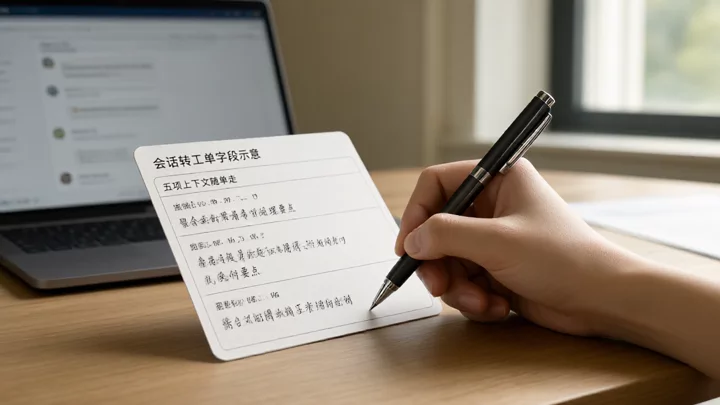
The five pieces of context to carry over when converting a conversation into a ticket
The act of transferring a ticket is simple; what is difficult is what to carry over during the transfer. The following five items are recommended as minimum requirements—whichever one is missing, you will pay a cost to fill it in at some later step.
- Account ownership: Which platform and which account it comes from. Consequence if missing: replies are sent from the wrong account, or when the same customer inquires again on another account, no one recognizes them.
- Platform and customer identifiers: The customer ID, nickname, or bound contact details within the platform. Consequence if missing: during handover, the only way to identify the customer is something like “the customer who speaks Indonesian.”
- Original and translated text: The customer's original words and the team's interpreted translation, with the language direction noted. Consequence if missing: no one reviews deviations in the translation's wording, and the person taking over has to translate it again.
- Customer language preference: Which language the customer is used to, and whether they accept mixed-language replies. Consequence if missing: follow-ups use the wrong language, reducing customer experience.
- Next actions and owners: Clearly state the to-do items, commitments, and time points. Consequence if missing: the ticket sits in the queue, but no one knows what it is waiting for.
These five items do not require a complex field design; many teams can handle them with a single spreadsheet. What matters is whether the person handing off the ticket is aware enough to fill them in, and whether the team treats 'fully filled in' as the sign that the handoff is complete, rather than treating 'ticket created' as completion.
How translations follow the ticket in aggregated translation scenarios
The value of aggregated translation is to make messages from different accounts and languages understandable in a single view. But 'understanding' and 'being able to hand off' are two different things. If the translation stays only in the chat window, the person taking over still sees content that needs to be re-understood; if the translation follows the ticket, the person taking over can directly judge what to reply.
It is recommended to keep both the original text and the translation in the ticket and mark the language direction. There are three reasons: first, the translation is a product of the team's understanding and may involve wording choices; when it comes to key information such as amounts, specifications, and time, the original text needs to be checked; second, the customer may switch languages later, and the original text is the basis for judging language preference; third, in case of disputes, the original text is traceable evidence, while the translation is only auxiliary.
In addition, the ticket should clearly state the 'points that need confirmation' rather than just 'translated.' For example, the customer may ask 'Can it ship by Friday?' while the translation may be written as 'ships on Friday'—the two have different meanings. Listing the ambiguity points that need confirmation separately is more practical than pursuing a perfect translation. For the understanding order of multilingual conversations, refer toBeyond lookworld real-time translation, how SKY SCRM supports multilingual customer communication and follow-upthe process breakdown in
Repeated inquiries from the same customer across multiple accounts: deciding whether to merge tickets
When the same customer appears across multiple accounts, this is the most common cause of duplicate follow-up in multi-account customer service. The judgment principle can be summarized as: same platform, same customer identifier, and same request can be merged into one ticket; cross-platform, different contacts, different orders, or different commitments should be linked as related tickets rather than forcibly merged. The risk of forced merging is conflicting commitments—two accounts give different answers, and the customer uses both responses to confront you.
| Scenario | Recommended action | Reason |
|---|---|---|
| Same platform, same customer, same request | Merge into one ticket and note the source account | Avoid duplicate replies from two agents and keep ownership clear |
| Same customer inquiring about the same matter across platforms | Create a linked ticket that points to the main ticket | Reply entry points differ by platform, but the conclusion must be consistent |
| Same customer, different orders or different commitments | Create separate tickets and reference each other | When committed times and content differ, mixing them together is error-prone |
| Different contacts, suspected to belong to the same company | Do not merge for now; note the related clues | Merging before identity is confirmed will contaminate customer records |
After merging, you must still retain the source account information; otherwise, during follow-up, you will not know which account to send from. This rule may seem trivial, but it is the step multi-account teams most easily miss. You can read further for approaches to handling assignments and backlogsWhatsApp tickets always piling up? Approaches to assignment and follow-up in multi-account customer communication.

Minimum recording standard for handover and follow-up
Before handover, at least four items should be clearly written in the ticket; if any one is missing, the person taking over will have to ask someone again or translate again:
- Current conclusion: What has been confirmed so far, what the customer has accepted, and what remains unconfirmed.
- Committed items: The terms, timing, and method promised to the customer; write them specifically, not just “communicated.”
- Points awaiting customer confirmation: Questions that require a customer reply before progress can be made; list them as items.
- Next follow-up time: Be specific to a date or time slot, not “as soon as possible.”
Records do not need many fields; what matters is that the person taking over does not have to go back through the original conversation. One practical test is to ask a colleague who was not involved in the conversation to read only the ticket and restate the customer’s request and next action; if they cannot restate them, the record is insufficient. For a complete checklist of lead assignment and follow-up records, refer toHow to structure a Telegram lead generation ticket workflow: a practical checklist from lead assignment to follow-up records.
Three-day small-scale validation: look at four handoff signals, not just response speed
When adjusting the handoff approach, you can first pick three days, two or three accounts, and real conversations to run through it once, and record four signals. They directly correspond to whether the “conversation-to-task” step holds, and this explains the issue better than watching response speed.
- Handoff context completeness rate:How many of the five context items were fully completed, and which item the gaps are concentrated in.
- Identification of duplicate inquiries across accounts:When the same customer appears under another account, did the team recognize it?
- Number of times the customer has to describe the issue again after handoff:If customers are forced to repeat themselves, it means the ticket did not carry enough context.
- Whether the follow-up happens at the agreed time:Whether the promised time matches the actual follow-up time.
None of these four signals requires complex statistics; a single table with manual entries is enough. A three-day sample is not enough to prove results, but it is enough to expose where the handoff breaks down—whether to fix the translation first or the handoff fields first; the answer is often right there in the records.
Where SKY SCRM sits in the chain.According to the current website information, SKY SCRM is an integrated translation and customer management system that supports multi-account management across global social platforms, multilingual communication, AI translation, and customer management. The handoff fields, merge decisions, and handoff standards discussed in this article are process design suggestions and do not constitute a description of specific tool fields or functions; the actual handoff approach must be verified by each team based on its own processes and the tools it uses.
Frequently Asked Questions
Do social platform chat records always have to be converted into tickets before follow-up?
Not necessarily. For one-on-one inquiries that can be answered on the spot, resolving them directly in the conversation is more efficient. Only matters that require cross-shift or cross-person collaboration, or involve commitments or amounts, are worth creating a ticket for. The criterion is whether the matter needs to be continued outside the conversation.
When customers inquire in multiple languages, should the ticket retain the original text or keep only the translation?
It is recommended to keep both and indicate the language direction. The translation helps the person taking over understand quickly, while the original text is used to verify key information and for traceability. If only the translation is kept, it is easy to lose the basis for verification when dealing with details such as amounts, specifications, and time.
If the same customer inquires across three accounts, how many tickets should be created?
If the three accounts are on the same platform and have the same request, they can be merged into one ticket with the source accounts noted. If they belong to different platforms or involve different orders, it is recommended to create linked tickets that point to the main ticket. The prerequisite for merging is that the commitments are consistent; otherwise, it is better to split the tickets than to create conflicting responses.
The team does not have a ticketing tool for now. Can a spreadsheet be used first to handle social platform conversations?
Yes. The five items—account ownership, customer identifier, original text and translation, language preference, and next action—can also be carried in a spreadsheet. The key is that the person handing over fills them in completely, so the person taking over does not need to go back through the conversation. The tool is only a carrier; whether the handover works depends on whether these items follow the task.
During the pilot, if customers repeatedly describe the issue after handover, should the translation be improved first or the ticket fields be changed first?
Check the ticket fields first. Customers repeating their descriptions is usually not because the translation is inaccurate, but because the person taking over cannot see the context and can only ask again. First add account ownership, original text and translation, and next action to the ticket, then evaluate translation quality. Reversing the order easily leads to wasted effort.