




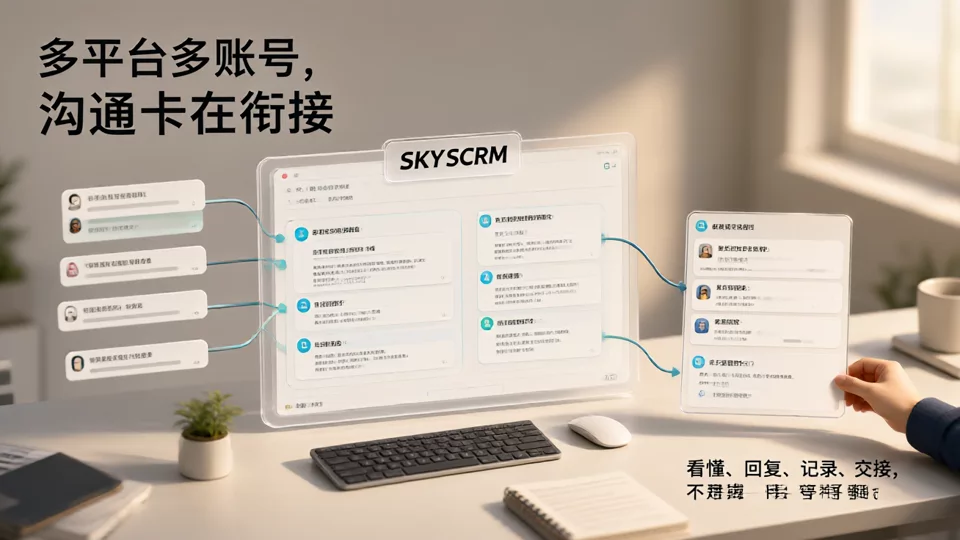
People who search for the "007 Overseas System" have often also searched for "transquickly" and "Twitter translation software." All three terms appear to solve language problems, but they actually point to different stages: one looks like a search for a system that can carry accounts and customers, while the other two look more like an entry point for understanding foreign-language content. What usually holds a team up is not any single translation, but the fact that once messages come in from two or three platform accounts, replies, records, and handovers do not connect.
This article discusses how such needs connect based only on publicly available business information from SKY SCRM—aggregated translation and customer management, multi-account management for global social platforms, multilingual communication, and AI translation. It does not verify or evaluate the features, ownership, or results of the "007 Overseas System," transquickly, or any third-party tool, nor does it offer download judgments.
In a cross-platform inquiry, what you need to catch is the conversation, not a single translation
A typical scenario: a customer first asks about pricing in English on one platform, then the next day switches to another account and sends an address and a model screenshot in Spanish, with a photo of a handwritten note in between. If the team only has a single-point translation tool, they can "understand" each step, but three things are lost at the same time: which platform account this message belongs to, what the customer asked before, and who should reply next.
Treating "understanding," "replying," "recording," and "handover" as the same problem is the most common misjudgment in this type of need. Translation solves only one part; customer management addresses what comes after that part—whether a message can stay attached to the same person and the same source account.
The test is simple: when a colleague takes over, can they say—without asking the customer—who the customer is, which platform account they came from, what language they communicate in, and where things got stuck last time. If they cannot, what is missing is not a translation but a conversation chain.
First, distinguish what each of the three search terms points to
Treating search terms directly as product features is where all later judgments start to go off track. The handling approach in the table below is only used to define the scope of discussion in this article; it does not represent a verification conclusion about any tool.
| Search term | What readers may be looking for | How this article handles it | What cannot be inferred from this |
|---|---|---|---|
| 007出海系统 | An operations system that hosts overseas accounts, messages, and customer records | Treat it as a search name pending verification, and do not identify it as an alias of this site or any product | It cannot be inferred that it has aggregated translation, multi-account management, or customer management capabilities |
| transquickly | A translation tool that may involve chat or text translation | It appears only as a searched tool name and is neither verified nor evaluated | It cannot be inferred which platforms it supports, whether it retains the original text, or whether it can connect to customer records |
| Twitter translation software | the need to understand foreign-language tweets, direct messages, or comments on Twitter/X | treat it as a single reading scenario, not as a customer management solution | It cannot be inferred that it can handle multi-platform messages, account ownership, or follow-up records |
Searching for all three together shows that the need has moved from "understanding a single sentence" to "whether anyone is still managing this message afterward." If you are only reading content, browser translation or built-in platform translation is often sufficient; once two or more accounts are involved, shift handovers are needed for replies, or customer historical questions need to be answered, the evaluation criteria should shift to account ownership, retention of the original text, and record continuity. For the difference between standalone translation and multilingual customer communication, refer toFrom single translation needs to multilingual customer communication: an overviewthe layered approach described there.
The disconnect occurs at three points: account ownership, translation comprehension, and customer records
If you break down the flow after a message comes in, the disconnect points in multi-platform, multi-account communication are concentrated in three places, not in the translation itself.
- Account ownership: if it is not established when a message comes in "which platform, which account, who is responsible," the reply may be sent from another account, and the customer sees a different identity.
- Understanding translation: Keep the source text and translation separate, or retain only the translation. Key information such as quotes, model numbers, and addresses can easily become distorted when paraphrased. SKY SCRM's publicly available business information includes AI translation and multilingual communication capabilities, but whether the wording matches your own business terminology still needs to be tested in actual business scenarios.
- Customer records: If language preferences, source batches, and initial requests are not recorded in the customer file, the next shift has to start asking all over again.
If any one of these three areas is neglected, the team will fall back to the old habit of forwarding screenshots to a group chat. For checking multi-account and collaboration configurations, refer toWhen a team needs multi-account communication on WhatsApp, clarify configuration and collaboration before running multiple instances of the ws software; how to reduce repeated confirmations for cross-language messages is covered inHow ws real-time translation reduces repeated confirmationsfor a more detailed breakdown.

When multiple accounts run in parallel, establish account ownership first, then discuss translation speed
Speed can be added later; once ownership is wrong, it is difficult to trace back. Before launch, finalizing these four items is more effective than comparing how many translation buttons there are.
- Account list and responsible parties:For each platform account, specify the owner, backup person, and available response time slots, so two colleagues do not use the same account to reply to the same customer at the same time.
- Customer language preference:Record the language the customer uses from the first conversation; do not guess based on country. When the same customer communicates in two languages, use the language from the most recent use.
- Storage location of source text and translation:Both should be visible at the same time and bound to the message and account, rather than copied separately into a spreadsheet.
- Handover fields:A handover should at least include the customer's identity, source account, current request, and next action. Missing any one of these means starting over.
Platform multi-account support only solves "being online at the same time"; what truly determines usability is the three parts: account ownership, translation binding, and collaborative handover. For applicable scenarios and boundaries of Instagram multiple accounts, refer toApplicable scenarios and operational boundaries for using multiple instances of ins software,the judgment logic is the same as in the WhatsApp scenario.
Turn “understanding” into something actionable by leaving at least four types of information.
Customer management is not about creating more tables; it is about ensuring that when someone else takes over the reply, they still know who the customer is, where they came from, and what they want. At the field level, all four types of information are indispensable.
- Source platform and account: Record which platform and which account the message comes from. This determines both the reply identity and where to continue the conversation later.
- Customer language and original text: Keep the customer's original wording, especially model numbers, addresses, specifications, times, and other details that cannot rely on paraphrasing.
- Translation and key terms: Translations are for quick internal understanding; quotation units and product names should preferably be standardized within the team to avoid multiple translations of the same term.
- Next step and owner: Every conversation should have a clear next step and time point; otherwise, the record is just an archive.
These four types of information also explain why a single translation window struggles to support multi-platform communication: it can see the text, but it cannot see the account, history, or responsible person. For differences in translation methods across platforms, refer toFacebook two-way translation vs. telegram real-time translationto determine which part should be handled by which type of tool.

Validate the “handoff” with a small-scale pilot rather than just listening to feature introductions
Feature lists all read similarly; the difference only becomes visible in a real conversation. Choose a multilingual inquiry that has already occurred, covering two platform accounts, and go through the following five steps.
- Bring messages into a unified view and confirm that the source platform and specific account are visible next to each message.
- Check whether the original text and translation are both retained, and whether terminology translations match team conventions.
- Reply once from the correct account and confirm that the customer receives the message from the corresponding identity.
- Have another colleague take over and see whether they can state the customer's request and next step using only the records.
- Check back the next day: can you retrieve this conversation and earlier communications using the customer name, account, or keywords?
If even one of the five steps requires manually filling in a spreadsheet, the chain is not yet connected. For implementation ideas for the Telegram scenario, refer toHow Is Telegram Real-Time Translation Implemented?, and the acceptance steps in it also apply to other platforms.
FAQ
Is “007出海系统” another name for SKY SCRM?
No. This name does not appear in the site's public materials. This article only treats it as a search term pending verification; it does not identify it as an alias of SKY SCRM, nor does it infer what features it has.
When searching for “transquickly,” should I look at translation quality first or account management?
It depends on where your bottleneck is. If you only need to understand a piece of content occasionally, translation quality is the main dimension; if messages come from two or more accounts and require shift handover follow-up, whether account ownership and record retention can be confirmed is more worth checking first—otherwise, no matter how fluent the translation is, you still won't be able to handle the customer.
Can “Twitter translation software” directly solve multi-platform customer follow-up?
It cannot be directly equated. It addresses the need to understand foreign-language content on Twitter/X, while customer follow-up also requires retaining information such as the source account, the customer's language preference, the original text and translation, and the next action.
What results should a small-team pilot record?
Record at least four items: whether replies are sent from the correct account, whether both the original text and translation are present, whether someone taking over can restate the customer's request, and whether messages from the same customer on different platforms can be viewed together. Judge by actual results, not by a feature list.