





First, Get Clear: Which Two Problems Are People Searching "Twitter Translation Software" Trying to Solve?
When you search for "Twitter translation software," the results often mix transquickly, 007出海系统, browser plugins, and various "one-click translation" recommendations. The needs behind these terms actually fall into two layers: one is simply wanting to understand a single tweet or a private message; the other is managing multiple Twitter accounts, receiving a daily mix of customer DMs in English, Spanish, and Arabic—understanding them, replying, and having someone continue the follow-up.
For the first layer, a free plugin is basically enough; for the second, it is not. The difference is not in translation quality, but in whether the account, language, original text and translation, and next steps are all retained together after a message comes in. The rest of this article only outlines a selection methodology: it does not verify, rank, or evaluate the specific products behind search terms like transquickly and 007出海系统, nor does it treat these terms as features of this site.
The Boundaries of Three Common Implementation Approaches: Platform-Native, Browser Translation, and Aggregated Translation
First sort the candidate solutions into three categories and determine which layer you are in—this saves more time than trialing each one. The descriptions in the table below reflect common patterns; actual performance still depends on each product's own documentation.
| Implementation approach | Account ownership | Two-way replies | Original text retention | Customer records and handover |
|---|---|---|---|---|
| Platform-native translation entry point | Stays within the current account and current conversation | Generally only helps with understanding incoming messages | Usually allows switching back to the original text | Does not involve customer profiles |
| Browser translation extension | Tied to the browser tab and breaks when switching devices | Can translate, but outgoing content requires separate handling | Easily lost after a page refresh | No handover fields |
| Aggregated translation tool | Connected on a per-account basis, with messages tied to accounts | Both incoming and outgoing messages can be translated | Both the original text and the translation can be retained at the same time | Customer records can be accumulated and handed over |
If you only receive a few direct messages a day and only deal with one language, the first category is enough. Once the combination of "three accounts, four languages, two people working in shifts" appears, the third category is what you need to evaluate.
What to check first when you find transquickly or 007出海系统
These are search terms, not conclusions for selection.Finding a name does not mean you already know what it does, which platforms it covers, or whether it supports multi-person collaboration. If you treat a search term as a solution and buy it directly, the risks usually show up in two places: account handover and customer context.
When you see an unfamiliar tool name, check four things first: whether the information comes from an official page or an aggregation and recommendation page; whether the platforms it covers include the accounts you use; how accounts are bound and whether multiple accounts can run in parallel; and whether the original text can be checked alongside the translation, and whether someone taking over can see the full history. Once these four items are checked, most candidates will naturally be filtered out, and the rest can move on to a trial.
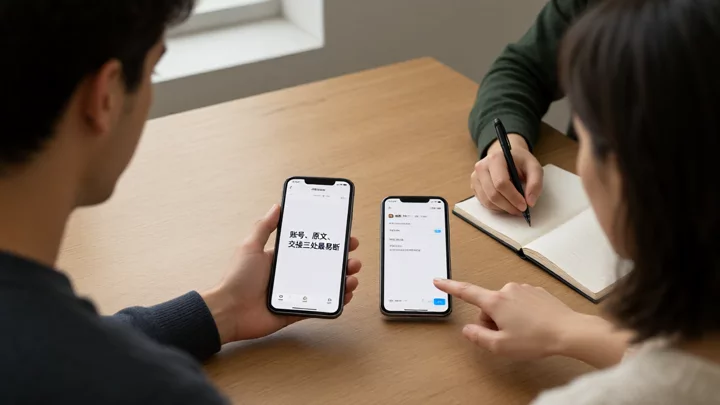
Five selection criteria for multi-account communication
- Whether account ownership is retained with the message.For the same question 'Is this model still in stock?', it must be clear on the message which customer from which Twitter account it came from. If ownership is lost, replies will be sent to the wrong account.
- Whether two-way translation covers both outgoing and incoming messages.Translating only incoming messages shifts the translation work onto people who know a foreign language; replies must also be translatable for cross-language communication to be a closed loop.
- Whether the source text and translation can be checked at the same time.For information such as model numbers, addresses, and amounts, a single mistranslation costs far more than not understanding it. The source text must be available for reference at any time.
- Whether customer profiles can be built up.If language preference, source, and first request remain only in the chat window, a shift handover means asking everything from the beginning. This point is addressed inAccount Management and Customer Follow-Up in the Instagram Chat Translatorwith a more detailed breakdown.
- Whether cross-platform expansion and handover are smooth.When Twitter is not the only platform and WhatsApp, Line, and Telegram are also in use, whether you need to buy another set of tools for each platform directly affects long-term costs. You can refer toChecklist for selecting multi-platform translation softwareandCriteria for evaluating multi-account management software.
According to the information on this site, SKY SCRM is positioned as an aggregated translation and customer management system that supports multi-account management across global social platforms, multilingual communication, AI translation, and customer management. Whether it suits your team still comes down to how the five points above perform in an actual trial, not to how many items appear on a feature list.

How to review after the trial: four actionable checks
Do not just test whether the translation is accurate during the trial; test whether a complete conversation can run through from start to finish. It is recommended to follow the order below, using real accounts, real languages, and real colleagues.
- Connect two or more accounts.Send one direct message from a customer in each different language, and see whether, when the message comes in, you can tell at a glance which account it belongs to.
- Do one round of two-way back-and-forth.Reply in Chinese and confirm that the other party receives it and the content is correct; then have them follow up once in their native language to check whether the context has broken.
- Check the original text once.Go back to the original message and verify key details such as model numbers, addresses, and times, confirming that the original text has not been overwritten by the translation.
- Have someone else take over.Have another colleague open the same conversation and see whether they can state, without asking, the account, the language, the customer's request, and the previous step taken.
If all four pass, the chain works end to end; if any one gets stuck, the problem is usually not in the translation engine but in the account, the records, or the handover step. Note that this article does not promise any translation accuracy rate, customer acquisition results, or response speed — these depend on the specific language pair, the complexity of the content, and the team's workflow.
If the team operates multiple platforms at the same time, you can combineImplementation approach for real-time translation on TelegramandScenario analysis of multilingual customer service translationLook at them together to avoid using a separate, disconnected tool for each platform.
Frequently asked questions
What is the difference between Twitter translation software and browser translation plugins?
Plugins solve “understanding this page and this sentence”; they follow the browser tab and break when you change devices or people. If translation software handles things at the conversation level, the difference lies in whether messages are attached to the account, whether both the original text and translation are retained, and whether customer information can be seen by the next colleague.
When I find transquickly or 007出海系统 in search results, can I choose based on ranking?
Not recommended. These are search terms; official pages, recommendation pages, and download sites are mixed together in search results, and ranking does not indicate whether it fits your account structure and collaboration style. First check the information source, platform coverage, account binding, and original-text retention, then decide whether to try it.
What should be checked first for multi-account Twitter communication?
Account ownership. Language can be supplemented by translation, but once a message is sent from the wrong account, the customer sees another brand name or another contact person, and the cost of explaining later is very high. The first direct message in a trial should come from the second account.
Must an aggregated translation tool include customer management?
It depends on whether you need handovers. For a team where one person uses a single account and replies to everything the same day, translation features alone are enough; for teams with shifts, customer follow-up cycles, and multiple platform accounts, customer profiles and context records directly determine the amount of repeated communication.