




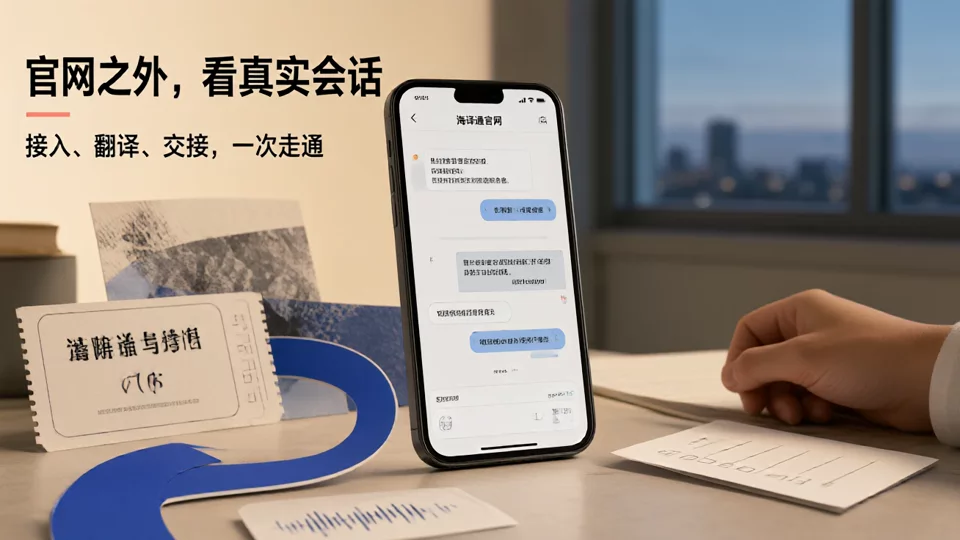
After opening 海译通官网, most teams still stall on the same question: the feature terms on the page seem to cover everything, so how do you judge which solution will actually work in your own multi-account communication? The reason is simple: a website describes a scope of capabilities, but what you need to solve is a specific conversation — a Vietnamese customer asking for a price on WhatsApp, an English-speaking customer chasing an order in a Twitter direct message: who replies, in which language, and where this lead lands once the conversation ends.
So a more effective approach is to treat the website as an entry point for information and the trial as the source of your conclusion. Prepare two real conversation samples (one WhatsApp inquiry, one Twitter direct message), first check whether accounts and translation connect properly, then check whether the customer information can be followed up and handed over after the conversation ends.
When searching for “海译通官网”, what are you really trying to judge?
Most people searching this term have already moved past the stage of “should we use a translation tool” and are comparing options or preparing for a trial. At this point, what really needs confirming is not the length of the feature list, but whether three links can form a single chain.
The first isaccount ownership: which platform, which account, and which customer a single message comes from, and whether the context is still there after switching accounts. The second isTwo-way translation: It is not just about understanding what the customer writes; it also includes whether you can reply in the customer's language, and whether the translation stays within the current conversation. The third isPost-conversation continuity: When a conversation ends, are the customer's language preference, key needs, and pending actions retained, and does the next person need to translate everything again when taking over?
If any one of these three breaks, no matter how many features there are, problems will surface when things get busy. For comparison dimensions in tool selection, refer toComparison and Judgment Points for Translation Tools in Social Multi-Account Management, while this article focuses on 'how to verify beyond the official website'.
What to look at first beyond the official website: turn feature terms into trial tasks
Expressions such as 'supports translation' and 'supports customer management' cannot be directly accepted, because they do not specify at which step they take effect. Only when feature terms are translated into tasks can a trial be comparable.
- Replace 'supports multi-platform access' with: keep accounts from two different platforms online at the same time, send one foreign-language message from each, and see whether both messages are assigned to the correct account.
- Replace 'supports instant translation' with: have the customer send an inquiry that includes model, quantity, and delivery date, and see whether key parameters are lost in the translation.
- Replace 'supports two-way translation' with: reply once in the customer's language, then have the other party follow up in another language, and see whether the conversation remains continuous.
- Replace “supports customer management” with: after you finish the chat and close the window, when you reopen it, can you see this customer’s history and to-dos?
- Replace “supports team collaboration” with: when this conversation is transferred to a colleague, does the colleague need to ask the customer about their needs all over again?
None of these five tasks depend on a vendor demo; they only require your own real conversations. The checklist items for the WhatsApp scenario can be refined one level further; see.WhatsApp Translation Feature Checklist and Usage Notes
WhatsApp Tickets: Focus on Whether a Conversation Can Become a Handover-Ready Task
“whatsapp tickets” mean very different things in different tools: some refer to to-do markers within a conversation, while others refer to a standalone ticket module. The name does not matter; what matters is whether, after the conversation ends, actionable, handover-ready information is left behind. During the trial, confirm the following points one by one and ask the other party to answer clearly with “yes” or “no,” not “supported.”
- Source traceability: Can the ticket bring back the original conversation, so that when you open it you can see the customer’s own words and the translation, rather than just a Chinese summary?
- Language continuity: Is the customer’s preferred language recorded on the customer or the ticket, and when the next colleague takes over, do they need to determine again which language to reply in?
- Field adequacy: Can items such as owner, priority, next follow-up time, and current status be set and modified manually, rather than being automatically generated and then impossible to adjust.
- Are handovers recorded? : When handing over, can the previous colleague's handling notes be carried over as well.
- Are the boundaries clear? : Tickets address internal task routing, while understanding and replying on the conversation side are handled by translation capabilities; do not conflate the two. For related process differences, seeProcess Differences and Selection Comparison Between Ticketing Systems and Multilingual Communication.
No assertion is made here about the specific features of any third-party tool: whether 海译通's official website provides the above capabilities, and in what form, should be based on the official website's descriptions and trial results.
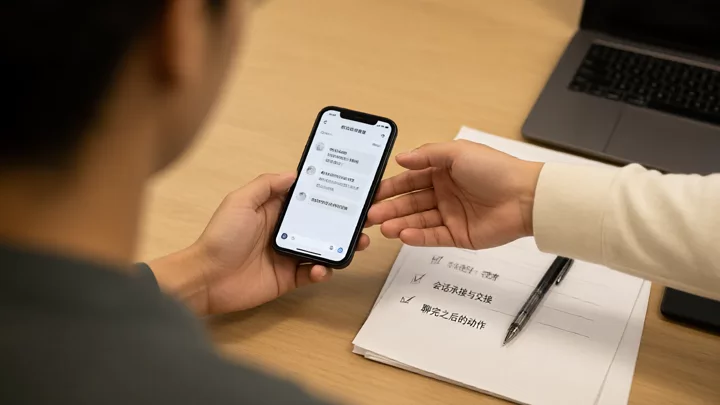
Two-Way Translation on Twitter: Don't Just Test One Chinese-to-English Sentence
Almost any tool can translate a single Chinese-to-English sentence smoothly, but actual communication on Twitter/X is far more complex: interactions under public posts, exchanges in direct messages, customers mixing abbreviations and emojis into non-English text, and the same customer appearing in different posts. Acceptance testing for twitter two-way translation should cover four aspects.
- Inbound direction:When a customer sends a direct message in Indonesian, Spanish, or Arabic, is the translation complete and readable, and are proper nouns and links preserved?
- Outbound direction:If you write in Chinese, can it output in the customer's language, and can you review it before sending, rather than discovering the tone is off only after it has been sent?
- Context distinction:Public replies and direct messages differ in tone, length, and information density; does the translation adapt to the scenario instead of using the same literal translation?
- Preference retention:Is the language this customer prefers and what was previously discussed kept in the record, and can it carry over when switching accounts or personnel?
When testing, it is recommended to use three consecutive messages from a real customer rather than making up a standard sentence yourself. For implementation points for direct message scenarios, refer toImplementation considerations for Twitter real-time chat translation, and for the differences between public posts and direct messages, seeTranslation tool assessment for reading Twitter posts and direct message exchanges.

A three-day trial checklist for multi-account teams
You don't need to onboard the whole team, and you don't have to wait until just before a major promotion to validate it. Pick two frequently used accounts and two real conversations, then record your findings over three days in the order below. This will tell you more than ten pages of introductory material.
- On the first day, test only the connection and ownership.Keep both accounts online at the same time and have each receive one foreign-language message. Record whether each message lands in the correct account, whether the customer name is consistent, and whether any messages are missed.
- On the second day, test translation and replies only.Reply once in the customer's language. Record whether the translation can be checked, whether the customer understood it after it was sent, and whether the context is still there when the customer asks a second follow-up question.
- On the third day, test only intake and handover.Transfer one of the conversations to a colleague. Record whether the customer's language preference, key requirements, and pending deadlines travel with the conversation, and whether the colleague has to translate again.
At the end of each day, write down in one sentence where things broke today. After three days, you will most likely be able to pinpoint the single critical break point. If it breaks at account ownership, the connection method needs adjusting; if it breaks at the translation, the language pair or terminology needs optimizing; if it breaks at handover, the record fields are not sufficient. This order of diagnosis also applies to assessing whether post-conversation follow-up is complete; for further readingMethods for customer follow-up after multi-account social communication.
Where does SKY SCRM fit in the selection process?
According to the public information on this site, SKY SCRM is an aggregated translation and customer management system that supports multi-account management across global social platforms, multilingual communication, AI translation, and customer management. If your needs happen to match the combination of "multiple social accounts + multilingual customers + communication records that need to be retained," you can add SKY SCRM to your shortlist and verify it item by item using the three-day verification method described above.
It should be noted that this article does not infer that SKY SCRM has specific functional forms not described in the materials, nor does it replace the information on the official 海译通 website. For the versions, prices, and feature scope of third-party tools, please refer to their official pages; when comparing tools, first test each with the same real conversation, and then compare the results.
Frequently Asked Questions
The official website says it 'supports multiple languages.' What kind of message is most effective for testing that?
Use the customer's own words with specific parameters: model numbers, quantities, delivery dates, and addresses mixed together, preferably with abbreviations or emojis included. This type of message can test terminology accuracy and context retention at the same time; standard greeting sentences won't reveal problems.
If you create an order right after chatting on WhatsApp, which fields are easy to miss?
The fields most easily missed are the customer's preferred language and the to-do time. The former determines which language the next colleague will use to reply, and the latter determines whether this lead will be forgotten; the owner and priority, by contrast, are usually filled in by someone.
Should translations of public replies and direct messages on Twitter be accepted separately?
They should be separated. Public posts are aimed at onlookers and should be short and quotable; direct messages involve orders and personal information and should be complete and verifiable. The same translation strategy often fits only one of the two.
What minimal information should a multi-account team record on the first day of a trial?
Four items are enough: which account the message came from, what language the customer uses, whether the translation was actually used, and where the information ends up after the conversation. If these four items line up, it shows the flow is basically working.