




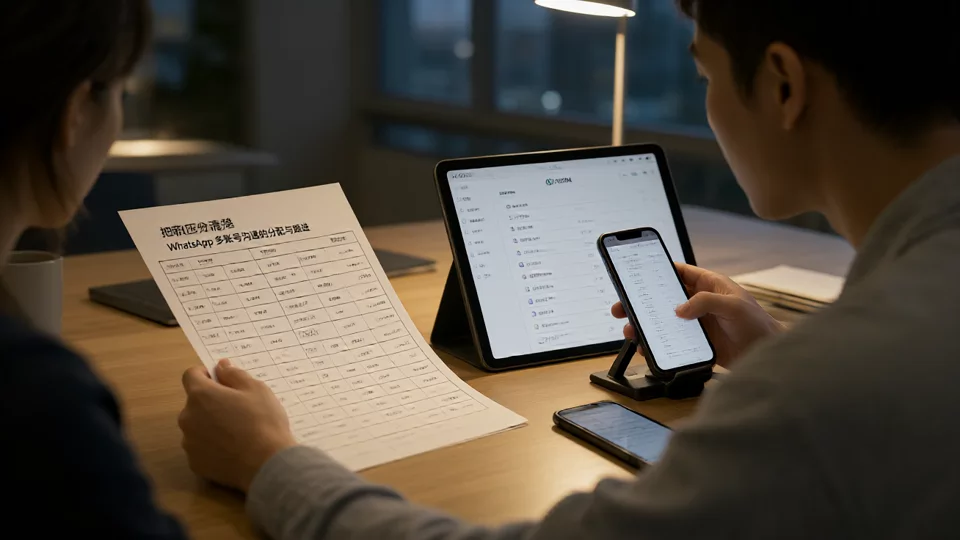
Three WhatsApp accounts, one shared spreadsheet, and dozens of records marked “to be handled.” The same customer asked about pricing once on account A, then asked again the next day on account B; in the spreadsheet it is two rows, and in the chat windows it is two people. When the manager asks “how is it going,” the usual answer is “all replied,” but no one can say clearly which record belongs to whom or when the next step is scheduled. This kind of backlog is rarely a matter of reply speed; it is that at the moment a conversation becomes a task, account ownership, language preference, and the next action are all lost together.
Below, I'll break this down in the order of “classify first, then set ownership, then define fields and statuses,” and at the end give a three-day small-sample validation method. “WhatsApp ticket” in this article refers to an internal team record of a conversation converted into a task, not an official WhatsApp feature.
First, determine which stage the backlog occurs in
Counting the four types of problems together leads only to the conclusion that “we're short-staffed.” Looked at separately, usually only one type genuinely needs more people.
| Backlog type | Typical symptoms | First action |
|---|---|---|
| Unclaimed | The conversation has come in, but no one in the chat window has marked “I’m handling it.” | Assign a primary owner and a backup person the same day, and write them into the record. |
| Pending translation confirmation | I understand the gist, but I’m not confident about the terminology or how to phrase the quote. | Write the uncertain points as a to-be-confirmed item and assign it to someone who understands the business. |
| Waiting for the customer’s reply | We’ve replied, but the customer hasn’t responded, and the record is still left open. | Add the time and method for the next outreach. |
| Lost in handoff | After a shift change or account switch, translate again and ask again. | Fill in the four fields first, then talk about switching tools. |
Account ownership comes before task assignment: each conversation has only one current owner
A common mistake is replying message by message: whoever is online answers. The result is that which account a customer was handled on and by whom depends entirely on memory. Ownership should be defined by “platform account + customer conversation”.
- List the accounts: clearly note the purpose of each WhatsApp account (pre-sales, after-sales, existing customers), the current login owner, and the backup person.
- Each conversation has only one primary owner. If a customer starts on account A and later asks again on account B, the primary owner from account A still follows up, or there is an explicit handover with a record.
- Confirm three things during handover: which account the customer is on, where the last message left off, and who will do the next step and when.
- Before switching accounts, review unfinished actions. List conversations that are “waiting for customer reply” and “pending internal confirmation” separately, then switch.
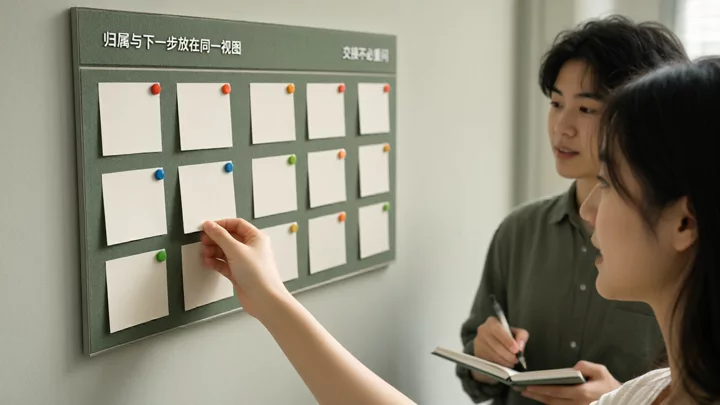
Turn chats into trackable tickets: leave at least four fields
It is not about having many fields; missing one means an extra round of questions. These four are the minimum:
- Source account: the platform plus the account name, which determines which identity to reply with and avoids replying as the wrong person.
- Customer reply language: the language the customer actually uses, together with how they prefer to be addressed and their currency preference, so the next person taking over does not need to determine it again.
- Current owner: write one person's name, not a team name.
- Next step timing and action: be specific about “what to send by which day of the week,” not “continue following up.”
Only when all four items are complete does the ticket meet the conditions for closure; if one is missing, this record effectively starts over after a shift change. In multi-account scenarios, the most common breakpoints are precisely the loss of these fields,Customer follow-up after social communication across multiple accountshas more detailed recording standards for this step.
Multilingual assignment must include language and time zone, not just translating a sentence
Aggregated translation and AI translation address “understanding” and “replying in the customer's language.” But what determines whether you can keep up is whether the customer's preferred language, time zone, and how they prefer to be addressed follow the conversation. When the same customer replies in Chinese in the morning and in English in the afternoon, the record should state the primary language and switchable languages; otherwise, the next person taking over will confirm it again, and the customer will feel that they are talking to a different person.
At the tool level, the capabilities described in SKY SCRM's public materials focus on multi-platform, multi-account aggregation, message notifications, AI translation, and customer management. Multiple social platforms and accounts can be switched within the same tool to handle customer conversations; specific platform compatibility is subject to the client andOfficial website feature documentationIts current content shall prevail. If ticket approval, SLA timing, or automatic dispatch is not listed in the materials, do not design the process as a built-in capability. When selecting a solution, refer toChecklist for aggregated translation toolsConfirm each item one by one.
Follow-up cadence follows status: New Inbound, Waiting on Customer, Waiting on Internal, Pending Review
Status is not a label but the field that specifies the next action. Each status must have an owner and a next time point.
- New Inbound:Confirm ownership and send the first verifiable reply; the condition for closing this field is “assigned and has a next step.”
- Waiting on Customer:Replied and awaiting a response. You must record the time and method of the next outreach; do not just leave it at “waiting.”
- Waiting on Internal:Blocked on a quote, inventory, or technical confirmation. State clearly whom and what you are waiting for; if the team-defined time limit is exceeded, escalate to the supervisor.
- Pending review: The customer is not placing an order for now or has already converted. Record the reason and the conditions for recontacting, and move them into nurturing instead of closing them outright.
The difference between “already replied” and “already followed up” is exactly the owner and the time for the next step. The former is just an action; the latter is what closes the loop.

Use a three-day small sample to validate the assignment rules
- Define the scope: use only 2 WhatsApp accounts, 1 primary owner plus 1 backup, covering real conversations from the last three days.
- Record four metrics: number of unclaimed conversations, first response time, second follow-up rate, and number of cross-account wrong replies. For definitions, refer toCommunication metrics for multi-account chats.
- Spend ten minutes before the end of each workday checking, assign new backlogs back to the previous four categories, and see which category is actually growing.
- After three days, only do an internal before-and-after comparison within the team: whether wrong replies have decreased and whether language and progress still need to be asked again during handover. If there is no improvement, adjust the fields and statuses first instead of adding people first.
We do not provide industry benchmarks here. Conversation structures vary too widely across categories and language markets; cross-sectional figures are not comparable when placed side by side, while internal before-and-after comparisons are more useful for judgment.
Tool boundaries: aggregated translation, customer management, and ticketing systems each cover a distinct scope
Aggregated translation addresses cross-language understanding, customer management addresses customer information and historical retention, and ticketing systems address internal routing and handoffs. The three are often conflated. People who search for “海译通官网,” “海译通工单,” or “独角兽工单” are mostly trying to confirm the capability boundaries of third-party tools—these names are outside the scope of SKY SCRM’s documented description, and this article does not treat them as features of this site. Similarly, “twitter双向翻译” only addresses understanding and replying across languages in X (Twitter) direct messages; it will not decide for you who a conversation belongs to or what to do next. For practical implementation, refer toPractical Considerations for Real-Time Translation of Twitter/X Direct Messages.
If you only need to solve “understanding foreign-language messages,” translation tools are enough; if the backlog comes from ownership and handoffs, go back to fields and statuses, then decide whether to introduce a ticketing system. For the differences between the two approaches, seeProcess Differences and Selection Comparison Between Ticketing Systems and Multilingual Customer Communication.
Frequently Asked Questions
In WhatsApp group chats, should tickets be created per message or per conversation?
Create them per conversation; for group chats, create them per “customer + topic.” Creating tickets per message splits the same issue into multiple records, and once there are many owners, no one is accountable for the outcome.
When are unclaimed records cleaned up each day?
Fixing a cleanup time before every shift handover is more reliable than "handle it when you see it." During cleanup, you only need to judge two things: whether there is an owner, and whether there is a next-step time; if either is missing, it counts as unclaimed.
The customer replies in two languages—which one should be recorded?
Record the primary language and note the switchable language. The basis for judgment is the language the customer used when raising the key requirement, not the language used in the last message.
When searching for a tool like "海译通官网," how can you tell whether it addresses translation, tickets, or customer management?
Look at three things: whether you need to manually record the conversation separately, whether customer fields are retained, and whether status transitions are managed. Tools that only provide WhatsApp translation downloads usually stop at the comprehension layer; you can compare them againstFeature checklist before downloading WhatsApp translationConfirm each item one by one; do not mistake translation capability for ticketing capability.