




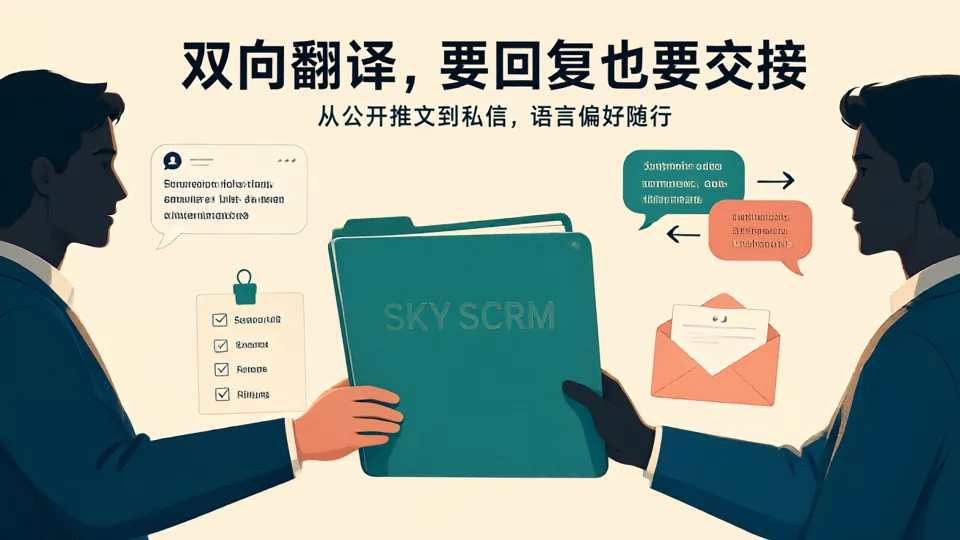
A typical Twitter/X direct message gets lost like this: the customer asks a question in English, with Vietnamese place names and model numbers mixed in; the support agent understands it but casually replies in English, and after the shift change, a colleague translates the same passage all over again. The problem is not the translate button; it is that two-way translation only completes “understanding” and does not complete “replying in the customer's language” and “handing over language preferences.”
Therefore, implementing two-way translation on Twitter should be split into three parts: understanding the customer's original words, composing a reply in the customer's language, and retaining language preferences, source text and translation, and account ownership. If any part is missing, customer communication will still break down, no matter how smoothly a single sentence is translated.
Start with the Links: Where Exactly Does Two-Way Translation on Twitter Need to Go Both Ways?
Two-way does not mean translating from Chinese to English and then back from English to Chinese. In customer communication, two-way has a clear direction: whatever language the customer writes in, the internal team must understand it accurately; whatever the internal team needs to express must be sent in a language the customer can naturally understand. The third part is often overlooked: the next shift's colleagues need to know which language this customer prefers, which words must not be translated loosely, and what was promised last time.
Public tweets, quote retweets, and direct messages are different scenarios. The public area is more about “deciding whether to join the conversation,” while direct messages are where details are delivered; both use the same translation, but the record-keeping requirements differ.
Scenario one: public tweets and quote retweets — first judge whether it is worth moving the conversation into direct messages
Two-way translation in the public area first serves judgment, not long-form replies.
- Read the customer's profile and their most recent tweets to first confirm their usual language, their market, and whether they have already raised a request in a public area. Use translation only to judge intent; do not treat machine translation as the customer's actual words.
- Look at the tone in quote retweets and reply threads. Sarcasm, urgency, price comparison, and after-sales sentiment often affect whether to move the conversation to a private message more than the literal meaning does.
- Reply publicly in the language the customer used most recently, and include only information that can be made public: thanks, confirmation of receipt, and a note that you will follow up by private message. Do not put order numbers, account details, price commitments, or private information in the public area.
- When you decide to move to a private message, record the link to the source tweet, the customer's handle, their usual language, and a one-sentence summary of their request before sending the first private message. This way, you will not need to start translating from scratch later.
Public replies and private message replies can use the same language or different ones; the criterion is where the customer most needs to understand what is said. If a sentence in the public area would expose order information, shorten it and move it to a private message.

Scenario two: How to decide the language for private message replies, and how to handle mixed languages and proper nouns
Judging the reply language in private messages in the following order can reduce most cases of “understanding the message but replying in the wrong language.”
- Prioritize the language used in the customer's most recent complete message. A reply of just “ok” or an emoji does not count as a complete message; look back to the most recent expression with actual content.
- If there is no complete message, check historical preferences; if there is no historical preference either, check the account's main market. Do not assume the customer accepts Chinese just because your internal colleagues all use Chinese.
- When languages are mixed, keep the original words and then confirm bilingually. Copy model numbers, place names, platform terms, and payment methods as they are first, then restate them with a sentence such as “My understanding is…”
- Do not force-translate brand names, links, @mentions, hashtags, numbers, dates, or emojis. Rewriting links or @mentions may mean customers cannot open them or find the right person.
- When you are not sure the customer can understand, give a brief recap and two options first, then the solution; do not mask language uncertainty with long explanations.
The goal here is to let customers understand and act with the least effort, not to pursue word-for-word correspondence. Translation quality should be judged by whether the customer has to ask again, not by whether the sentences read beautifully. For more detailed requirements on response speed and record-keeping, seeHow to Implement Real-Time Twitter Chat Translation: Three Considerations on Response Speed, Context Understanding, and Customer Records.
Scenario three: what must be left behind in the handover when multiple accounts and multiple people work in shifts
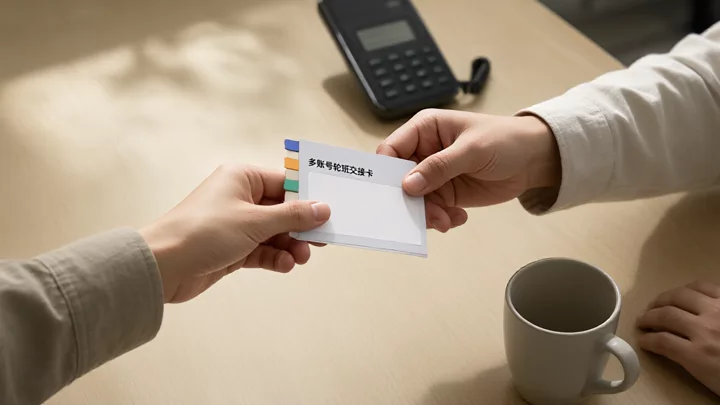
When multiple accounts and multiple people work in shifts, a translation is only useful if it stays somewhere that can be handed over. Screenshots, chat logs, and verbal explanations are not enough, because the next shift needs to quickly answer four questions: what language the customer speaks, what was actually said, which account it came from, and what to do next.
| Handover field | What to write at minimum | Why |
|---|---|---|
| Customer language and preferences | Language of the most recent complete message, historical preferences, whether bilingual communication is accepted | Decide which language to open with on the next shift |
| The key request in the original and its translation | Key sentences from the customer’s own words, internal translation, and uncertain terms | Avoid losing model numbers or tone in second-hand retelling |
| Account and contact | Which Twitter/X account, customer handle, and owner | Prevent replying to the wrong account or following up twice |
| Content already replied and next steps | Language sent, commitments made, and time points | Enable shift staff to continue the work directly |
The minimum standard is to place the original text and translation side by side, not to keep only the translation. If only the translation is kept, proper nouns and tone will be lost in the second-hand retelling; if only screenshots are kept, search and statistics cannot be done. In multi-account scenarios, account ownership must also be written into the same record; otherwise, replying to the wrong account is more serious than mistranslating a sentence.
Implementation boundaries: two-way translation is not the same as automatically taking over customer communication
When implementing, distinguish three layers: single-sentence translation only solves “understanding”; Twitter two-way translation must solve “replying in the customer’s language and leaving a handover-ready record”; customer management is responsible for holding the context across multiple accounts and multi-person shifts. The three layers overlap but cannot replace one another. Internal task routing after a conversation ends belongs to another layer of process and should not replace the reply-language judgment and handover fields discussed in this article.
This article only discusses implementing two-way translation in Twitter/X conversations. If evaluating SKY SCRM, check its aggregated translation and customer management capabilities against its publicly stated business scope; for specifics such as the Twitter/X integration method, translation display, and record fields, refer to the actual product interface and do not infer functions beyond the provided information from this article.
Trial acceptance: use 20 real direct messages to check five things
During the trial, do not conclude with a single sentence like “the translation is quite accurate.” Prepare 20 real direct messages covering at least three languages, two accounts, and one shift, and check five things one by one:
- Whether you can reply directly in the customer’s language, rather than only understanding it and asking a colleague to write the reply;
- Whether each conversation indicates which Twitter/X account it comes from and which person is responsible;
- Whether key sentences, proper nouns, and tone in the source text are preserved, and whether the translation can be compared with the source;
- Whether the customer’s language preference and “words not to translate” can be passed on during handover;
- After the conversation ends, whether customer information, requests, and next steps can be carried forward and enter follow-up.
If evaluating SKY SCRM, check aggregated translation and customer management capabilities against its publicly stated business scope, and do not treat this article as a feature list. For tool selection, you can also refer toHow to Choose a Twitter Translation Tool: Practical Criteria from Reading Posts to DM Exchanges; for a more complete explanation of multilingual communication and follow-up workflows, seeBeyond lookworld Real-Time Translation: How SKY SCRM Supports Multilingual Customer Communication and Follow-Up.
Frequently Asked Questions
If a customer asks in English but the message history is in Vietnamese, which language should I reply in?
Use the most recent complete message with actual content as the basis. If this message is in English and the customer has actively switched, reply in English; if it is only a short “ok” or an emoji, still follow the historical Vietnamese preference.
Should links, @mentions, and hashtags be kept as-is after translation?
Keep them as-is. Translate only the surrounding explanatory text; links, @mentions, and hashtags may break or point to the wrong object if altered. The same applies to numbers, dates, model numbers, and brand names; if necessary, add a brief explanation in parentheses after the translation.
What is the minimum information to record during a two-person shift handover?
At least four items: the customer’s language and preferences, the original text and translation of key requests, the corresponding account and contact, and the content already replied plus the next step. Keeping only screenshots or only translations is not enough; the next shift cannot verify the original wording or account ownership.
If the language used in a public tweet and a direct message is inconsistent, which context should guide the reply?
Decide separately: in public areas, use the language the customer most recently used in the public area and include only information that can be made public; for direct messages, reply in the language of the most recent complete message in the direct message thread. If public content would expose order information, shorten it and move it to a direct message.